Creamy Rice with Peas and Asparagus

pea asparagus rice

There is a beautiful quarterly cookbook/magazine called Canal House cooking.  It is founded by two friends who meet together every day to talk about what they had for dinner the night before, and then they get cooking.  They decided to start writing down their recipes and what resulted was this beautiful magazine book.  I like to try recipes out that are in season, and so I am currently going through their Spring issue.  And even though there aren’t a  lot of fresh peas in our produce bins, I know that they are currently in season somewhere out there in lands where it rains, so I felt this was still an appropriate recipe for an overcast May day.  Asparagus is also in season, so I added some chopped up that I had roasted a few nights before and it was a really excellent addition.  Canal House calls this dish Risi E Bisi  (rice and peas) and it’s just that simple.

This is an excellent dish for little ones.  The comfort of soft rice and cheese and the addition of greens and a dab of butter makes this dish all-inclusive. For smaller, toothless ones, this would be so simple to pulse a few times with an immersion blender!  Olive still doesn’t like asparagus, but I think I’ve only given it to her 5 times.  I’m going to try at least 15 more times before I determine that she does not, in fact, love asparagus.  I challenge any  mom out there to do the same!  Case in point: I had nearly determined that Olive didn’t like peas until I hadn’t given them to her for a week or so, and then tried again and she gobbled them up.  I realized that familiarity equals good for a child.  So if you make a wide variety of vegetables simply familiar to a child, the enthusiasm will soon follow.  I believe this with all my heart, even on days where Olive spits out anything green.  One day she won’t, and I’ll be glad I didn’t let her under-developed, under-exposed palate determine her food preferences!

green rice

Creamy Rice with Peas and Asparagus
serves 6

2 tbs extra virgin olive oil
4 tbs butter
1 onion, finely chopped
2 cups fresh peas (you could also use frozen, as I did and it turned out great)
salt
6 cups hot chicken or vegetable stock
1 1/2 cups arborio rice, or other short grain rice.  I didn’t have any on hand, so I used plain long grain white and it was just fine.
1/2 cup freshly grated parmigiano-reggiano
pepper to taste
1 bunch asparagus, roasted at 400 with olive oil, salt and pepper until tender

Heat the olive oil and 2 tbs of the butter together in a heavy medium pot over medium heat.  Add the onions and cook until soft and golden, 5-10 minutes.  Add the peas and season with salt.  Cook for a minute or two, then add 1 cup of the hot stock.

Cover the pot, reduce the heat to medium-low, and simmer the peas until they begin to soften, about 5 minutes.

Stir in the rice and 4 cups of the remaining hot stock. Cover the pot and adjust the heat to maintain a gentle boil.  Cook the rice, stirring occasionally, until tender, about 20 minutes.

Remove the pot from the heat and moisten the rice and peas (if needed and too thick) with the remaining cup of stock (I didn’t do this step – my rice didn’t absorb as much as arborio would have) Stir in the remaining 2 tbs of butter and half of the cheese.  Fold in the chopped, roasted asparagus if you want.  Season with salt and pepper and serve sprinkled with remaining cheese.

Freezer Staple – frozen shrimp

7G9A1631

This could be considered the first post of many where I will talk about the joys of a well stocked kitchen/pantry.  There are a few things shown in the pic above that should be in every well-stocked kitchen.

1. Rice.  I keep several types of rice on hand: Basmati (so flavorful for Indian and Thai dishes) Brown, Sweet (sticky rice for Asian desserts), Long Grain and White short grain.  It’s easy to store, it’s cheap (usually no more than $2 per pound) and in a pinch, you have an instant side dish.

2. Onions/Leeks/Shallots – Don’t keep these in the fridge.  DO keep them in a dry, dark place in your kitchen, separate from other fruits and vegetables.  I don’t always have leeks on hand, but I DO always have onions and shallots.  When I’m at the grocery store, whether I have a recipe in mind or not, I assume that I will need onions.  I usually buy medium sized, sweet yellow or Spanish onions.  I would guess that 9 out of 10 recipes I make include onions in some form.  Okay, maybe 10 out of 10.

3. Frozen Shrimp.  Kind of the wild card that you might not think of, but in the frozen section, usually near the meat department in both grocery stores and big chain stores (walmart, target, etc).  They come in a few options: raw with shell, raw, shelled and deveined or cooked.  Get the raw, shelled, deveined.  You don’t want to have to fuss with peeling shrimp and you definitely don’t want to mess with removing the poop chute.  You may not think that you’ll use shrimp often enough to always buy a bag when you’re buying other frozen items, but you’d be surprised.  Shrimp tacos, shrimp lettuce wraps, shrimp stir-fry, or coconut shrimp and rice…

Coconut Shrimp with Basmati Rice*
serves 4

1 tbs butter
1tbs extra virgin olive oil
1 large leek (about a cup, white and pale green parts only – halved lengthwise, rinsed and sliced thin)
4 scallions (white and some green tops, sliced and save some for a rice garnish)
2 garlic cloves, minced
1 1/2 pounds large shrimp
1 tsp curry powder
salt and pepper to taste
1/4 cup dry white wine or chicken broth
1 cup coconut milk
2 tbs fresh cilantro, chopped
1 cup of dry Basmati rice, cooked to package instructions

Melt the butter with the olive oil in a large skillet over medium heat.  Add the leek, scallion strips, and garlic and cook, stirring, until the leek starts to wilt, about 2 minutes.  Add the shrimp, curry powder, and salt and pepper and cook, stirring, until the shrimp turn pink, about 2 minutes.  Add the wine or chicken broth and cook, stirring, until the liquid is reduced by half-about one minute.  Add the coconut milk and simmer until the shrimp are opaque throughout, about 2 minutes.  Remove from the heat, add the cilantro, and let stand, covered, for about 10 minutes to meld the flavors.

Serve on top of rice, garnished with extra scallion and cilantro, if desired.

7G9A1636

*recipe adapted from the Bonne Femme Cookbook

Asparagus Tart – Roasting is still the best way to eat vegetables

asparagus tart 3

I know I said I’d write about what got the most requests on my question last week, but I haven’t had time to do a good job with the requests I got, so that will come at a later post.  The top requests were for kale.  Honestly, I’m a bit stumped.  What, exactly, is the mystery?  Put it in stuff?  Ha!  That would be my suggestion.  Stir it into soups, toss it in salads and wilt it a bit with warm roasted chicken or hot bacon.  However, I don’t want to be flippant, so I will look up some good uses for kale, the sad-replacement-for-chips, and get back to you.  The other suggestion that intrigued me was for proper hash browns.  My friend, Maria, said that she had tried them several times and hadn’t gotten that good, diner-esque texture to them.  Honestly, I haven’t, either.  So I am interested to look up ways to cook hash browns well and that will most definitely be a post, as it will be a learning process for me, as well.

Today I wanted to simply give you an awesome recipe that we had last night for dinner, as our “starter” dish.  A beautiful use of asparagus (hey, Tracey, you asked for asparagus recipes, too!) and a lovely and exciting way to serve them that feels indulgent (bet you’ve never used that word in association with asparagus) and fun for children, and even doable for one-year-olds learning to eat bigger chunks of food.  Olive ate about 6 bits of this tart and then she was done. I consider that a success.

Having a box of frozen puff pastry in your freezer at all times is a good move.  This stuff can make you look like a fabulous cook in about 20 minutes.  You can top it with anything and bake and have great appetizers, desserts, or a crust for a savory tart, like this one.

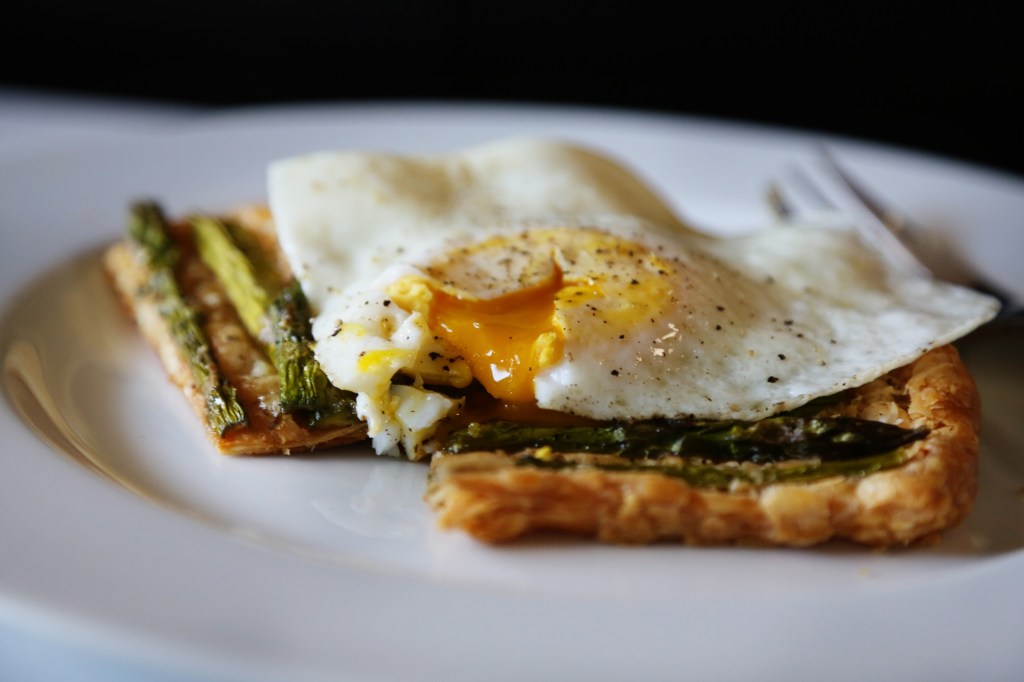
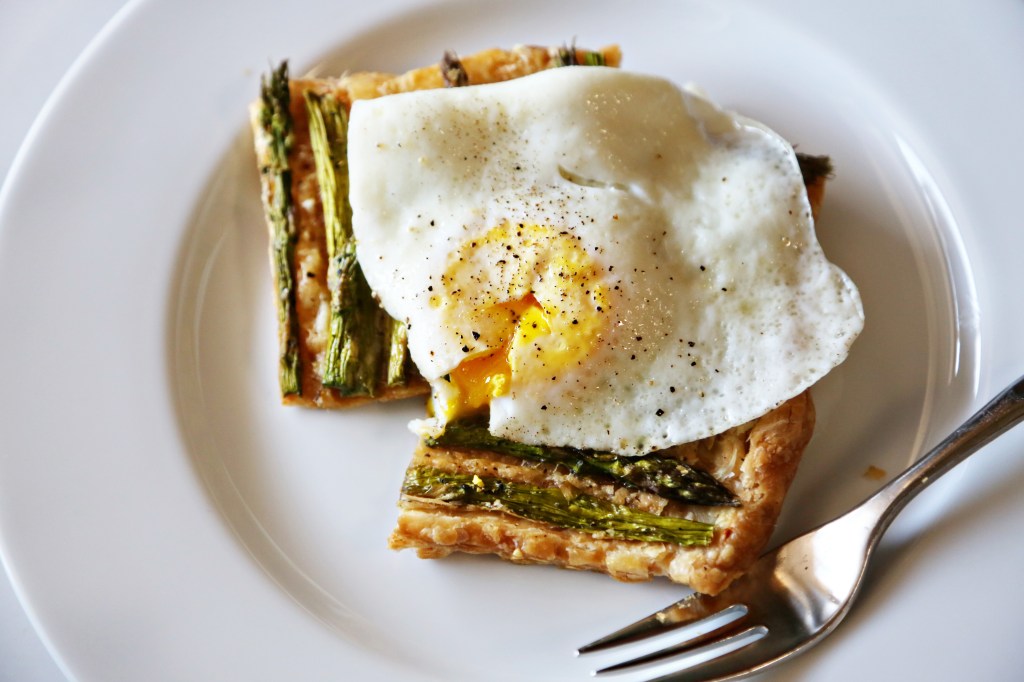
Also, I wanted to mention my deep love and perhaps borderline obsession with using up leftovers.  My goal at the end of most weeks is for my fridge to be empty, save condiments and milk.  It’s good to think of ways to use up your leftovers and I know no better way than to use eggs to achieve almost-better-than-the original-meal leftovers.  This morning, I took leftover pieces of the asparagus tart and fried an egg and put it on top.  Lots of fresh ground pepper and a few drops of hot sauce.  So good.

breakfast2

Asparagus Tart

serves 4

1 sheet of puff pastry, thawed
1 bundle of fresh asparagus, ends snipped and cut in half, length-wise (I found that this helped them cook faster than the original recipe)
Olive oil to coat the asparagus – 2 tbs
Freshly ground pepper and kosher salt
2 oz shredded Manchego cheese – Parmesan or Swiss would also work

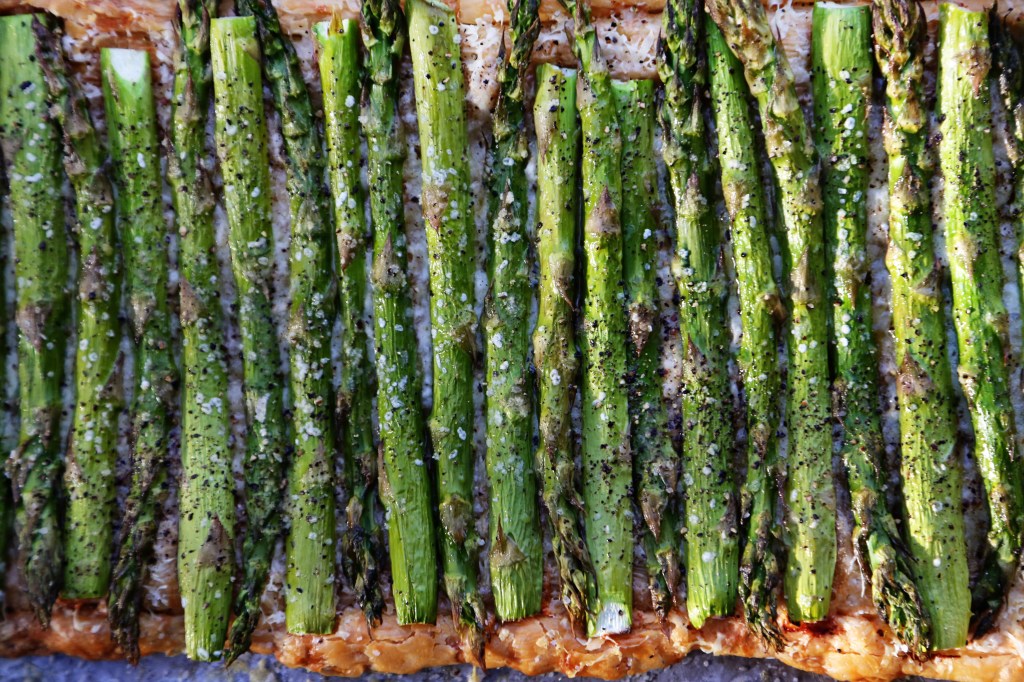
Preheat the oven to 400F.  On a greased, rimmed baking sheet, roll out your puff pastry to about 9×13″ rectangle.  Poke all over the bottom with a fork and bake for 15 minutes, until golden.  Toss your asparagus in olive oil. When the pastry comes out, it will have shrunk.  It’s okay, I swear.  Cover the tart in the shredded cheese and lay your asparagus spears side by side, touching, and alternating head to toe (this just makes more asparagus fit and it looks prettier.)

asparagus tart 1


Sprinkle the top of the tart with salt and pepper.  If you have leftover asparagus spears, just place them, cut side down, on the baking sheet around the tart.  They turned out to be gloriously crispy when they came out.  Bake for 25 minutes until the asparagus is nicely wilted and slightly browned.  Let cool slightly, cut with a sharp knife into squares and serve!

In the morning, heat leftovers in a 350F oven and fry an egg to place on top.  Enjoy with a cup of coffee and try not to think about the fact that it’s only Wednesday.

asparagus tart 2

breakfast

*original recipe from Martha Stewart Living

Green on Green Salad

green on green 2

It’s the first day of Spring!  I used to be a complete fall/winter gal, and as far as loving cardigans to a fault, I still am.  But the new mother side of my life has made me  crave warmer weather, the ability to leave the screen door open so we can hear the birds, and not worrying if my kid is constantly too cold.  This time last year, I had a two week old baby in the house.  We were scared and bewildered, yet happy to have her as a part of our pack.  It’s been such a learning process.  Is there a “right” way to do things?  Well, if there is, I was sure on the hunt this year.  I asked every person I knew who might have an ounce of understanding or empathy, what they thought the “right” way was to feed/sleep/play/instruct my baby.  I’m sure they, like me, are breathing a sigh of slight relief that along with her first birthday passing, so has a large amount of my questions.  I think part of me craves that close knit village type atmosphere of raising a baby.  Mothers, grandmothers, aunts, cousins; all within arms reach of advice.  While that isn’t our reality, I am very thankful for technology that has made virtual villages out of our spread-apart lives.

One of my favorite parts of this “virtual village” is the way in the short time this blog has been up and running, I’ve been able to answer questions of fellow moms across several states on the basics of cooking, what to cook for baby, where on earth do you get Chinese 5 Spice?! and so on.  I love cooking so much and I hope that along the way, I can make at least one other person excited to cook a meal for their family or try something new.  I love when someone tells me, “I salt my pasta water because of you” (which is funny because at least three people have told me this, and I learned it from Mario Batali. Salty like the ocean!) I feel useful, even though I might be stuck in this house (or feel stuck from time to time), I feel knit together with so many by a common ambition for the quest for good food and a simple sense of accomplishment.

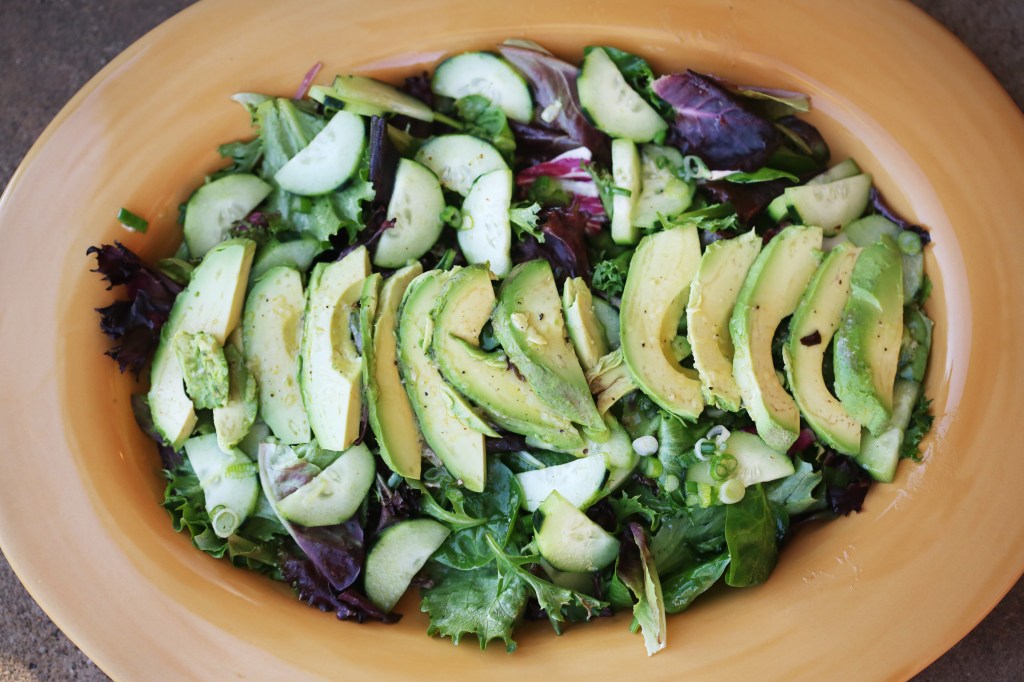
This salad is once again, from THE best cookbook of my year, so far, The Bonne Femme cookbook.  I served this salad with the broccoli and cauliflower recipe from Monday and seared chicken breasts with a simple pan sauce  (butter, chicken stock, pan drippings, reduce, reduce, reduce) and sliced, toasted almonds.  Very filling meal, very heart healthy – no one felt deprived!  (baby side note: Olive didn’t try this.  She was still sickly when I made it.  Will try again with her soon)

Green on Green Salad

serves 4

1 garlic clove, minced
Salt and freshly ground black pepper (about 1/4 tsp each)
2 tablespoons fresh lime juice
4 tablespoons extra virgin olive oil
2 teaspoons honey
a few drops of Tabasco, Cholula, Tapatio, or whatever peppe sauce you like best
4 cups baby arugula or just a bag of mixed greens
1/2 cup, halved, thinly sliced cucumber
1/4 cup thinly sliced scallions
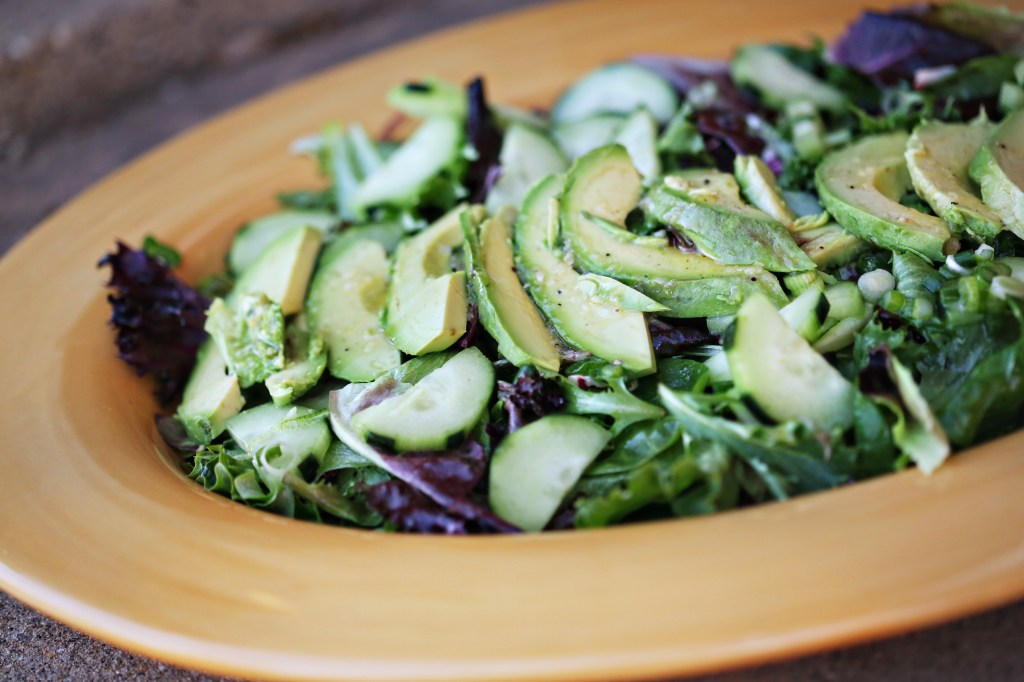
1 avocado, peeled and sliced

In a small bowl, use the back of a spoon (or I use a drink muddler) to mash the garlic clove with the salt and pepper.  Add the lime juice and whisk until the salt is dissolved.  Add the olive oil, whisking until incorporated.  Whisk in the honey and red pepper sauce.

In a large bowl, toss the greens with enough dressing to make the leaves coated, but not too heavy.  Arrange the arugula on a large platter.  Toss the cucumber and scallions with a bit of the dressing and arrange them on top of the greens.  Arrange the avocado slices across the top of the salad.  Drizzle just a little more dressing on top of the avocado and serve.

green on green 3


Confession Time and a Side Dish You Never Thought You’d Love

roasted broccoli

I said I’d be honest on this blog and today is just such a post.  Last week, a sweet friend of mine said, ” You are officially one of those moms that makes me question my ability to fully parent and live well/completely.” I wasn’t exactly sure what to do with that comment, but I think I know, now.  It’s time to be honest!  Last week wasn’t good.  Olive got sick on Tuesday with her first stomach bug in her little year on this earth.  It wrecked her appetite, needless to say, and she subsisted for the rest of the week on mostly bananas, bits of bread, small bites of chicken and forced bites of a few benign vegetables like carrots and…carrots.  My little super-eater turned into the “picky eater” kid and even today, isn’t back at full steam.  She plays fine, acts fine, but when it comes to eating – it’s a fight.

I tried my best to stay the course; don’t force her, don’t get stressed, if she doesn’t eat much at lunch, she’ll catch up at dinner – but I was fearful all week that this stomach bug would make her afraid of food, of eating, of trying new things and in one week, all would be lost.  You think I’m exaggerating for the sake of this blog.  I wish I was.  I guess, today, my confession is that I try too dadgum hard to make things go perfectly, and when they don’t, I feel like an utter failure.  Perhaps this isn’t the day to write because last night I slept maybe three hours (my inability to turn my brain off and relax) but I thought about my friend’s comment on my status, and I just wanted to tell her that we only show our best online.  We only write statuses we are either proud of or find ironically funny.  So no one heard all week how scared I was that Olive was sick, or how miserable I felt when she wouldn’t eat a bite all day for a couple days in a row.  And of course I didn’t write statuses about how I got angry with her and made her cry because she kept dropping food off the side of the high chair.  I don’t like writing about that part of life.  The hard part.  The part that makes you question if you’re doing everything wrong and will, inevitably, scar your child when it’s all said and done.  I thought, “How much would everyone love if Olive ended up hating a variety of food just because I want her to love food so much?”  And it’s sad, but I really do feel that most of the people I know would secretly laugh if that happened.  And I can’t say that I blame them.  I’m very passionate about cooking and food and banning “kid-food” and teaching children to eat well and have manners at the table.  I wouldn’t say that I have much camaraderie in that area, at least not locally.  Or maybe I just don’t feel it because I’m not admitting to the hard parts that happen, as well.  I’m only telling you that she ate baby bok choy with fish sauce vinaigrette last week and loved it.  Not that she cried big, fat tears today because I wouldn’t let her hold a fork while she ate (she’d just throw it or poke herself in the face).  Sigh.

Our hard week came to a head this morning as Olive had her one year check up and got 5 shots in her little legs.  So, I made a soup for her for lunch.  Cream of celery, and I pureed the heck out of it so that there’d be no chunks.  I just didn’t feel like challenging her today. She ate fine.  Not as much as last week, but enough.  And I will continue to do what I know in my heart to be best.  Let her be a person with feelings and a new found opinion on things, and try not to force her to like something just because I do.  She’ll come around.  And if today, she only wants the texture of soups and yogurt, then that’s fine.  Maybe tomorrow she’ll eat something more challenging.  The point, I think, is to get back to the heart of what makes food and cooking beautiful: it’s something to be shared.  Eating, first, should be enjoyable.  Not nutritious, not organic – but delicious.  Good for the soul.  Shared with family and friends.  Happy.  Stress-free.  Not another lesson to pass or fail.  I vow to back off in my intensity for success at having a “good eater” a bit and get back to what makes food so amazing.  It’s good.

An incredible way to enjoy a couple of vegetables that might not be everyone’s favorite is first: roast them till they’re a little crispy.  And second: toss them in a vinaigrette!  In today’s recipe, that vinaigrette is one that contains fish sauce and it’s incredible.  I know you wouldn’t typically put “fish sauce” and “incredible” in the same sentence, but you’ll start to once you try this.  Also, it’s from David Chang’s genius book, Momofuku, and I’m pretty sure he’s never made anything bad in his life.  It’s so simple and the vinaigrette recipe makes a lot, so you can save it in your fridge to toss with pretty much any roasted vegetable.  The original recipe called to toss it with roasted brussels sprouts, which is a vegetable most think they don’t like.  But I’m pretty convinced you’re always just one recipe away from liking something you thought you never would.  So!  Try this today and let me know what you think.  Fish sauce can be found in most Asian sections of supermarkets near all the soy sauce, but if you have trouble, you can definitely find it at any Asian mart in town.

roasted broccoli and brussels sprouts


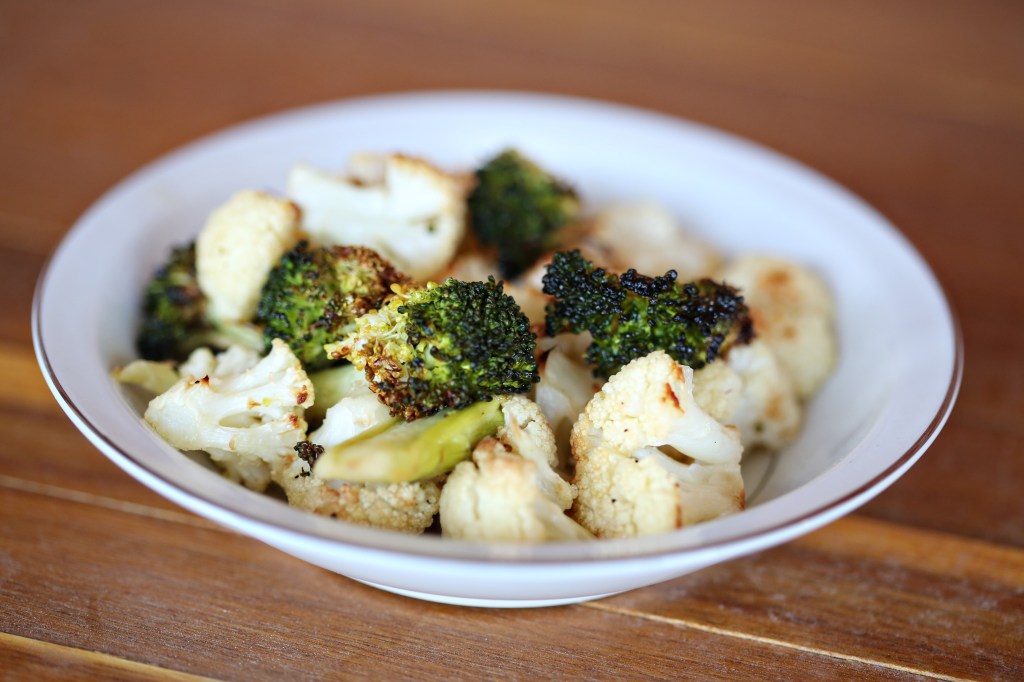
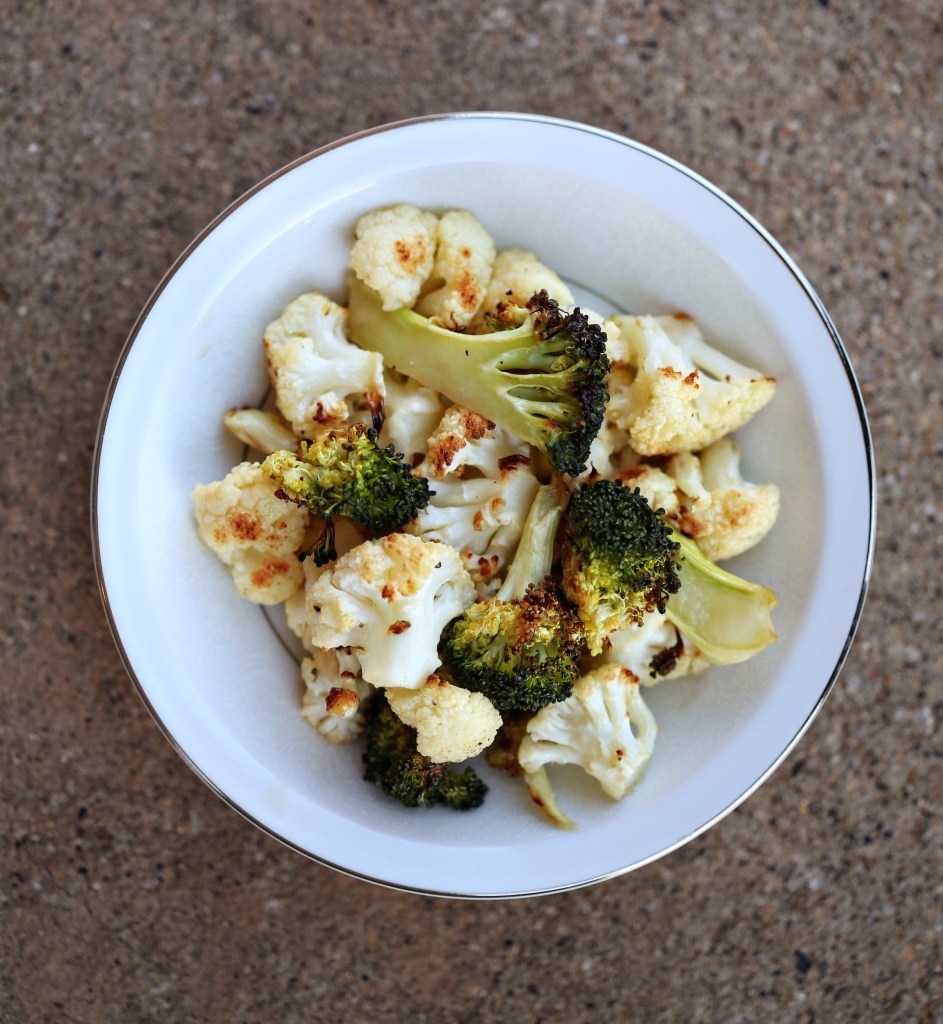
Roasted Broccoli and Cauliflower with Fish Sauce Vinagrette

1 medium head broccoli
1/2 head cauliflower
Olive oil
Salt and pepper to taste
4 tbs Fish Sauce Vinaigrette (recipe follows)

Preheat oven to 400F.  Cut up the broccoli and cauliflower into small, bite sized pieces.  I trim the “trees” in half so that they roast better.  You want to aim to make the size of your vegetables all nearly the same so they cook at the same rate.  Toss in a couple tablespoons of olive oil and spread out on a large rimmed baking sheet.  Don’t crowd the pan.  Put it on two pans if you need to.  Sprinkle with salt and pepper and roast for about 20 minutes, or until they start to get kinda crispy and browned on the edges like in the photo above.  When they’re done, toss in a large bowl with the vinaigrette and serve immediately.  For some reason, broccoli gets cold faster than any other vegetable known to man.

Fish Sauce Vinaigrette

1/2 cup fish sauce
1/4 cup water
2 tbs rice wine vinegar
Juice of 1 lime
1/4 cup sugar
1 garlic clove, minced
1 to 3 red bird’s-eye chilies, thinly sliced

Combine everything in a large mason jar with a tight fitting lid.  Or any container with a tight fitting lid that won’t leak.  Shake it all around until the sugar dissolves.  Keep in the fridge for up to a week.

Time for Spring

We have less than ideal weather conditions in this region.  Lubbock has some of the worst dirt storms imaginable, the worst wind and the hottest summers.  We’ve been suffering through a drought the past 3 years and two years ago it was the worst we’d seen in nearly a century.  No rain that year from January till April of the next year (and even when the rain did come, it was one or two light showers).  Trees died and were uprooted, everyone’s yards were yellow like straw.  Farmers had to look for employment elsewhere, wildfires burned up homes, livestock, and thousands of acres of land.  Everywhere there were severe water restrictions and the people who cheated could be seen a mile away with their green, foot-thick sod yards that they clearly watered around the clock.  Needless to say, things haven’t been growing very well for aspiring back-yard farmers lately.  But with a few inches of rain last year and a few inches of snow this winter, we are more hopeful for the spring.  There’s still watering restrictions – we can only water on Tuesdays and Fridays, using either drip irrigation or standing there, holding a hose, but we are optimistic that maybe this year, something can grow.

Seeing growth is healing.  When you sow a seed and water it and leave, trusting that it will grow, you have faith in the purest form.  And when that faith is rewarded by a tiny, green shoot popping out of the dirt (and it’s not a weed) it gives such a rush that you want to do it again and again.  I’ve never been a successful gardener (rain helps) but this year, I’m going to try my best.  Choosing vegetables that say “full sun” is a start, and I’m focusing on herbs, which are used most frequently and are the most pricey per-ounce at the store.  And since nearly every single recipe in my most recent cookbook obsession calls for parsley, chives, tarragon, or chervil, and chervil is no where to be found in this town, I’m going to just grow my own.  (Lord willing.)

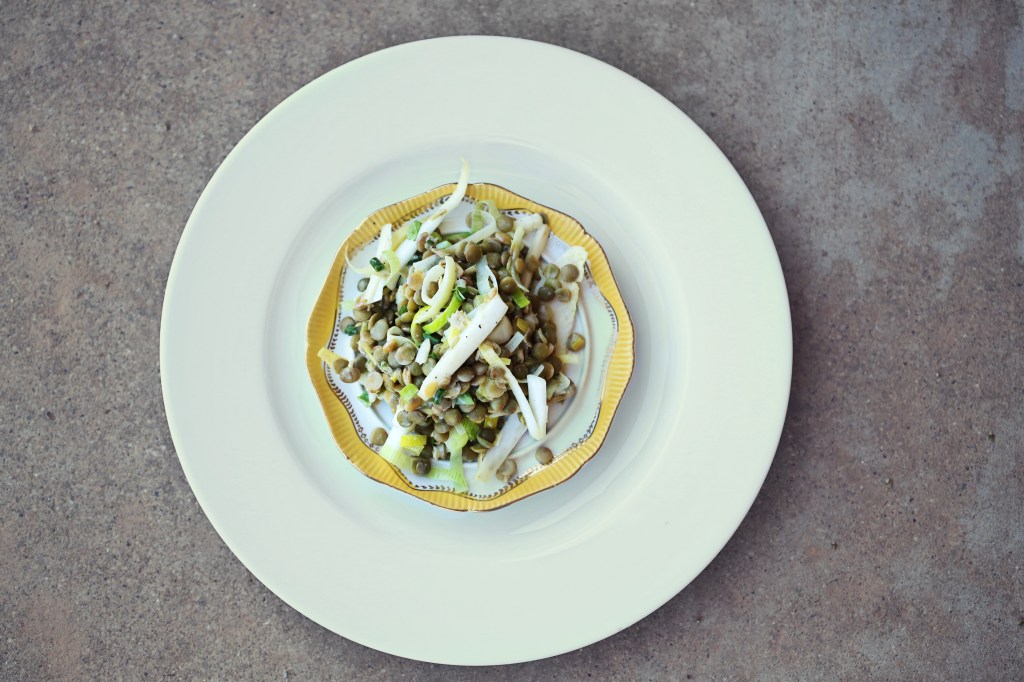
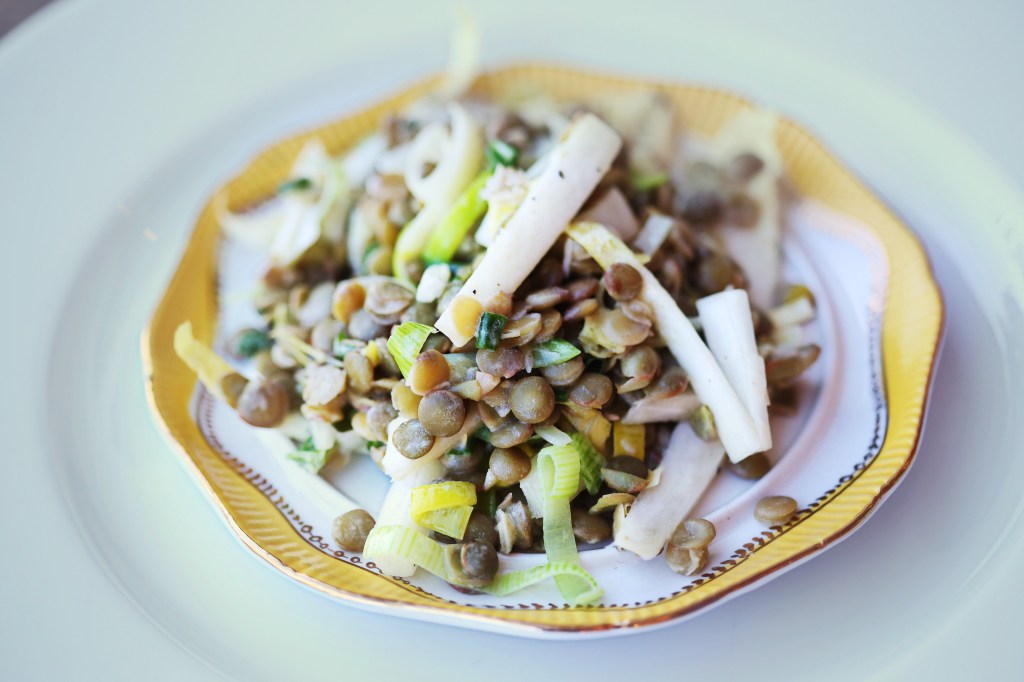
After working in the yard today and feeling the warmth creeping in the air, I decided to keep dinner light tonight.  I chose a green lentil, leek and endive salad and roasted some free sausages Matt got as a thanks from the butcher for buying a good cut of beef on Saturday.  Odd, but hey, we’ll take it.  And you’re welcome, Mr. Butcher.  Thank YOU for carrying dry-aged USDA prime.  Oh, and Olive wasn’t a fan of the texture of this salad.  She immediately scraped her tongue with her fingers to get every last lentil off.  Ah well, at least she tried it! green lentil salad 2 green lentil salad1

Green Lentil, Leek and Endive Salad

serves 4 to 6

1 cup green lentils
3 cups water
3 tbs extra-virgin olive oil
1 leek (white and pale green parts only), halved lengthwise, rinsed, and thinly sliced
1 garlic clove, minced
1 large head Belgian endive (or two small), root trimmed off and leaves sliced
1 tbs snipped fresh chives
2 tbs heavy cream
1 tbs white wine vinegar
Salt and pepper to taste

Rinse, drain and pick through the lentils to discard any debris.
Place the lentils in a large saucepan with the water and bring to a boil.  Reduce the heat and simmer, partially covered, until the lentils are tender but still firm, about 15 minutes.  Drain, rinse with cool water, and drain again.  Transfer the lentils to a serving bowl.
Heat 1 tbs of the olive oil in a small saucepan over medium heat.  Add the leeks and cook, stirring, until they are slightly wilted but still have some crunch, about 2 minutes.  Add the garlic and cook, stirring, about 30 seconds more.  Add the leeks and garlic to the bowl with the lentils, along with the sliced endive and chives.
In a small bowl, whisk together the remaining 2 tablespoons olive oil, the heavy cream, vinegar, and salt and pepper.  Add this dressing to the lentils.  Toss to combine.


Serve the salad immediately at room temp.  Sear off some sausages for a full meal.

Cod with Brussels Sprouts and a Garlic Cream Sauce

codsprouts

I ran across a wonderful blog the other day that is an answer to a question I’d been asking myself since I first read Bringing up Bebe and French Kids Eat Everything.  What is a good example of a weekly menu that a typical Frenchie would have in their home, every day, WITH a baby?  Behold, the lovely blog, French Foodie Baby, written by a French woman who lives in L.A.  At the beginning of the week, she posts a menu of what they’ll be eating for lunch, snack (gouter) and dinner.  I love how adventurous she is with her cooking and while she has the luxury of living in a city with tons of markets and options, I have found that I can adapt the recipes pretty well for us.

French kids only have one snack per day and it’s usually at 4 p.m.  We’ve already started this habit in our house with Olive that she doesn’t eat anywhere but the table, and she only gets one snack around 3 or 4.  If she acts hungry 30 minutes before dinner, either Matt or I will go distract her in the other room by playing until dinner is ready.  She is usually quite hungry for lunch and dinner and does pretty well at restaurants because she’s hungry and will eat as long as we do (while turning 360’s in her high chair to check out the scene, of course.) As two moms at a restaurant pointed out the other night, “She’s been sitting here for an hour! Well, just wait till she’s two…”  Ah, the “just you wait” threat.  Moms give it to me on a weekly basis.  I am fully aware that a year old is way different than two, and that we will have to be extremely diligent in our efforts at mealtimes, but I’m confident that starting now, instead of at two, or whenever the eating issues arise, will make things much easier for us in the future.

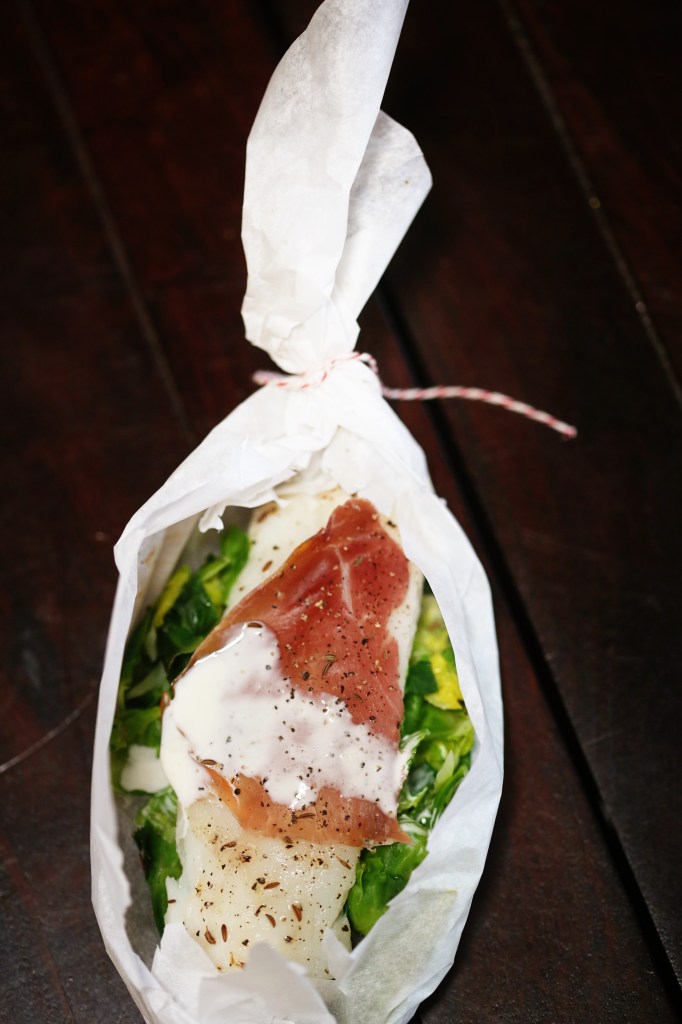
This fish recipe was taken from the French Foodie Baby blog nearly word for word.  We enjoyed it very much, but I will warn that if this is the first time your baby has had roasted garlic, go easy.  (she suggests the baby be 8-10 months old for trying this for the first time.  We gave Olive’s portion a rough chop so they’d all be bite-sized pieces) Olive’s diaper the next day was…epic.  My fault.  She’d had plenty of garlic before, but maybe it was just too much?  Anyway, I would suggest straining out the garlic clove before preparing a small portion for your baby.

codsproutscream

Cod with Brussels Sprouts and Garlic Cream Sauce

Serves 4

1 lb Brussels sprouts

5 garlic cloves
1 1/4 cup heavy cream
1 lb cod fillets (this turned into two large filets for me, but I cut it down into 4 portions)
4 thin slices of pancetta (I had proscuitto in the fridge and it worked just fine)
4 pinches of caraway seeds
Salt & pepper
Preheat the oven at 350°F.
Bring a large pot of salted water to a boil. Quarter the Brussels sprouts and wash them. Plunge them in the boiling water for two minutes, drain them and cool them off under cold running water. Set them aside on a kitchen towel.
Wrap the garlic cloves (unpeeled) in parchment paper and bake them for 15 minutes.
Remove the skin and mash them with a fork. Combine with the heavy cream in a small saucepan and set aside.
Cut the cod into four pieces, and cut 4 squares of parchment papers.
On each square of paper, place a bed of Brussels sprouts, a piece of black cod and a slice of pancetta on top. Sprinkle with pepper and some caraway seeds.
Wrap the parcels and tie each end with kitchen string.  (Note: you can make these ahead of time and keep them in the fridge until ready to bake)
Place the four parcels directly on the bottom of the oven and bake 12-15 minutes.
Place the saucepan with the garlic and cream over low heat. Add a sprinkle of salt and some pepper. Bring to a low simmer.
Place each parcel on a plate, open it and pour the cream of garlic over the fish.
codsprouts finished

Poached Egg Salad with Bacon and Sherry Dijon Vinaigrette

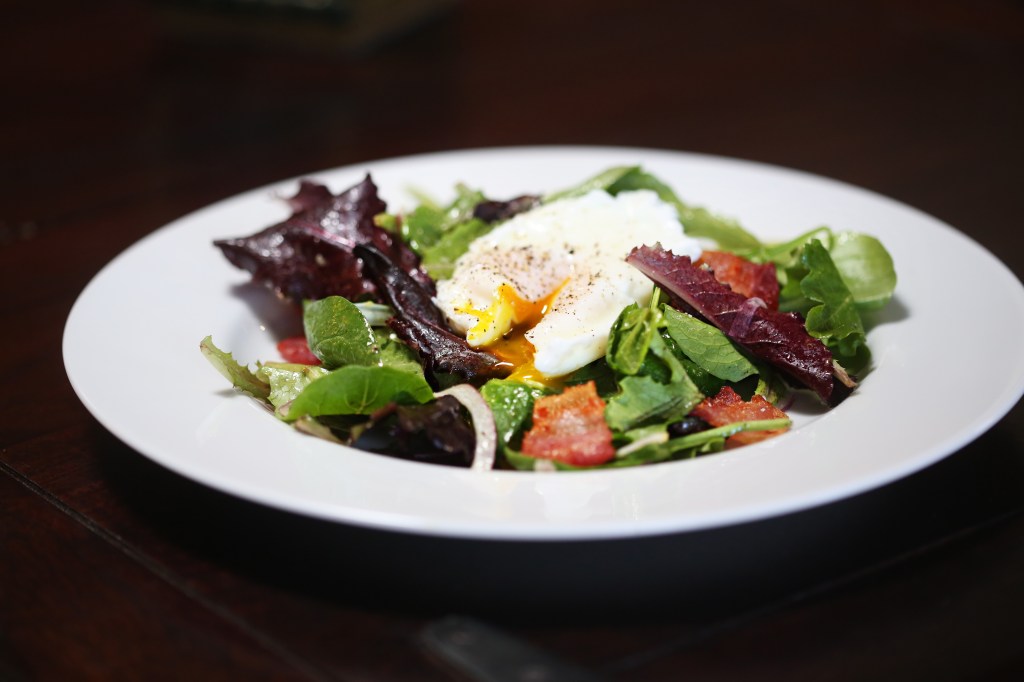
Poached Egg Salad with Bacon and Sherry Dijon Vinaigrette

Everything about this salad is good.  The vinaigrette is simple to make and extremely satisfying to me, a reformed cream-based dressings only kind of person.  I’m from Portales, NM – we like ranch dressing more than we should.  Any time Matt would order a vinaigrette at a restaurant, I would scoff as if he were simply trying to make a point that I should choose a healthier option because how could he really prefer a vinaigrette?  Well, I think you could easily prefer this one.  This salad has enough richness from the bacon (just one strip per person) and the poached egg that when it’s all combined, everything balances out perfectly.  This recipe is again, from the genius and simple, Bonne Femme Cookbook.  I think I’m unintentionally cooking my way through this book.  I made a diversion last week and cooked out of the Everyday Food magazine and while all the recipes were good, once I started this week cooking out of Bonne Femme again, I think Matt and I were both secretly relieved.  I can’t quite put my finger on why all the recipes work so well – I haven’t screwed up one, yet, and I’ve made nearly a dozen different recipes!  Maybe the mystery is that the French like everything to have a sauce?  It certainly creates a warmth for every meal that would be lacking otherwise.  And even with all these sauces, I’m still losing weight (down two more last week)  Woohoo!

So here’s to a salad with a sauce all its own when the yolk combines with the vinaigrette.  I made it a bit heartier by roasting some asparagus to have along side.  Asparagus and runny egg yolks are best friends, by the way.

Scared to poach an egg?  Well, you can buy one of those insert things that you put into a pot on your stove, or what I did was bring a medium saucepan to an active simmer (not boiling – I left my burner on medium heat), crack your egg into a small bowl first and then get your water swirling in a tornado fashion and then dump your egg into the middle of the swirling water.  It will look like a walleyed mess at first, but after 3-4 minutes, you can check the egg with a slotted spoon and if your whites are done and your yolk still feels jiggly to the touch, then it’s good to go.  The recipe suggests putting two tablespoons of white wine vinegar into your water to keep the whites from scattering so much. I forgot to do this, but am anxious to try again, soon.

Poached Egg Salad with Bacon and Sherry-Dijon Vinaigrette
serves 4

4 slices thick cut bacon, but into 1-inch pieces
3 cups torn mixed greens
1/2 cup sliced red onion
4 large eggs
1 recipe Sherry Mustard Vinaigrette (recipe follows)
Salt and pepper to taste

Cook the bacon in a skillet over medium heat until crisp; remove from the skillet and drain on paper towels.
Toss the greens and red onion in a medium sized salad bowl.
Poach your eggs to desired done-ness, adding 2 tbs of vinegar to the water before adding the eggs.  Here’s another tutorial on how to poach an egg.
When the eggs are almost done, toss the bacon in the bowl with the greens and add enough vinaigrette to coat the leaves well – you may not need the whole recipe and less is more – an over dressed salad gets soggy  and gross really quick.
Arrange the salad among four serving plates and top each with a poached egg.  Season the egg with salt and pepper and serve immediately.  If you want to serve it with the asparagus, I’ve got the recipe for you below.

Sherry-Mustard Vinaigrette

In a small bowl, combine 1 clove of minced garlic with salt and freshly ground black pepper to taste.  Mash them together with the back of a spoon to make a rough paste.  Add 1 tablespoon sherry vinegar; whisk with a fork until the salt is dissolved.  Whisk in 2 teaspoons Dijon mustard.  Slowly add 3 tablespoons extra-virgin olive oil, whisking until incorporated.

Simple Roasted Asparagus

Wash and trim your asparagus.  Coat all the stalks in 2 tablespoons of olive oil.  Sprinkle evenly with salt and pepper.  Roast in a preheated 400F oven for 15 minutes.  Squeeze a few drops of lemon juice over and serve!

The Humble Omelet – if you have eggs, you have a meal.

It’s Monday.  In the fridge, there’s a half eaten container of fried rice, a tub of yogurt, some loosely covered bowl of something I ate last week in the very back and an almost empty container of milk.  I haven’t been to the store to stock up for my week of ambitious cooking at home but I don’t want to immediately admit defeat and head out to eat for lunch.  This happens every week.  And nearly every time I think there’s nothing good to eat for lunch, I realize that I have eggs.  If I have eggs, I have a meal.  Because there’s almost always some bits of cheese, unused herbs, bits of leftover meats or veggies or some leftover that can be incorporated into an egg dish.  If you have eggs and an onion and potato, you can make a hash.  If you have eggs and leftover veggies, you can make a frittata.  If you have eggs and nothing else but butter, you can make an amazing omelet.  Goodness, I’m glad I’m not a vegan.

Many esteemed chefs have done their share of obsessing over the simple preparations of an egg.  Chef Gordon Ramsay has the cooking of an egg as an exam, of sorts, for cooks aspiring to work in his restaurants.  Chef Wolfgang Puck had an omelet making contest as a qualifying exam for the most recent season of Top Chef.  Julia Child is famed for her demonstration of cooking a French omelet, much like the recipe I’ve written about here, and it was Jacques Pepin who taught my husband how to roll an omelet using just the pan.  Eggs are simple and beautiful and need hardly any embellishment to make a wonderful meal.  The recipe below is almost as simple as it gets.

omelet1

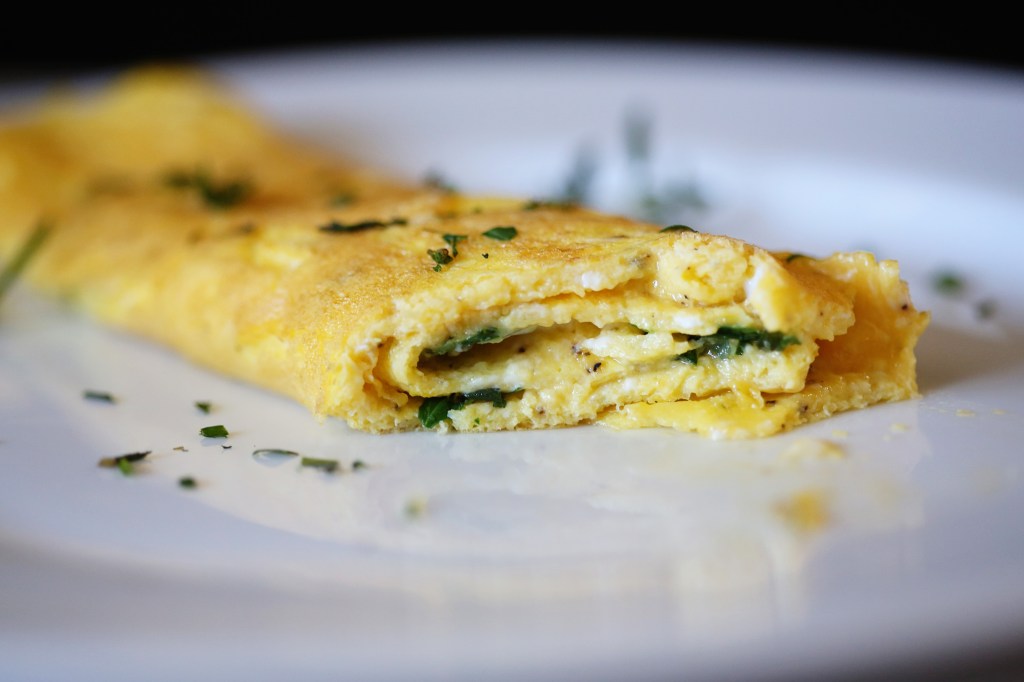
If you’d like to fill your omelet with more items, try bits of soft goat cheese, some shreds of Parmesan, crispy pieces of prosciutto or sauteed mushrooms.  Don’t overfill.  This is an IHOP move and it’s what we’re typically used to, but for this recipe, you’re not going for a burrito effect where the eggs act as a tortilla.  You’re really showcasing how a delicately seasoned and well cooked egg can be immensely satisfying and flavorful and not too filling.

A Simple Omelet – serves 1, even after looking in the fridge and determining there is nothing to eat.

3 eggs, room temp (set eggs in a bowl of warm water and they’ll be room temp in half the time)
Salt and pepper to taste
1 tablespoon unsalted butter
1 teaspoon fresh herbs, roughly chopped (we primarily use thyme and chives)

Crack your eggs into a separate bowl and whisk very well until no separation of whites and yolks remain.  Season with salt and pepper – really just about a 1/4 teaspoon and a few grinds of pepper.  Over-salting an egg is a grave mistake that you just can’t come back from.  It ruins them.
Heat the butter in a large, non-stick pan over medium heat (my skillet is a 10″.) Put two plates into a 200 degree oven to keep warm.  As we all know, eggs cool off REALLY quickly.  This helps.
Pour the eggs in and swirl the pan around to cover the bottom.  With a spatula, stir the eggs around in the center – don’t mess with the sides yet – create holes and shuffle things around for the first few seconds the eggs are in the pan.  As you shuffle and create holes and gaps, swirl the pan around and fill in the holes with the runny eggs.  Do this a few more times till the liquid in the egg starts to dissipate but still looks a little runny on top.  At this point, sprinkle your herbs over half the omelet.  Carefully, run your spatula around the edges of the pan and flip about a 1/4 of the omelet over itself from right to left.  If you’re deft with the pan skills, you can dump the egg onto your plate and roll the omelet up perfectly while doing so.  I don’t possess such skills yet, although I will continue to try.  I just use the spatula and continue to fold my omelet from right to left till it’s completely rolled up.  This creates nearly four folds.

omelet2

See the thin layers?  I must give credit where credit is due – Matt made this beautiful, delicate omelet.  The inside is cooked and yet still creamy and not dried out.

Garnish your omelet with extra herbs and enjoy!   Skip the 5 o’clock rush at the grocery store tonight and stay home.  If you have eggs, you have dinner.

Roasted Butternut Squash with Brown Butter

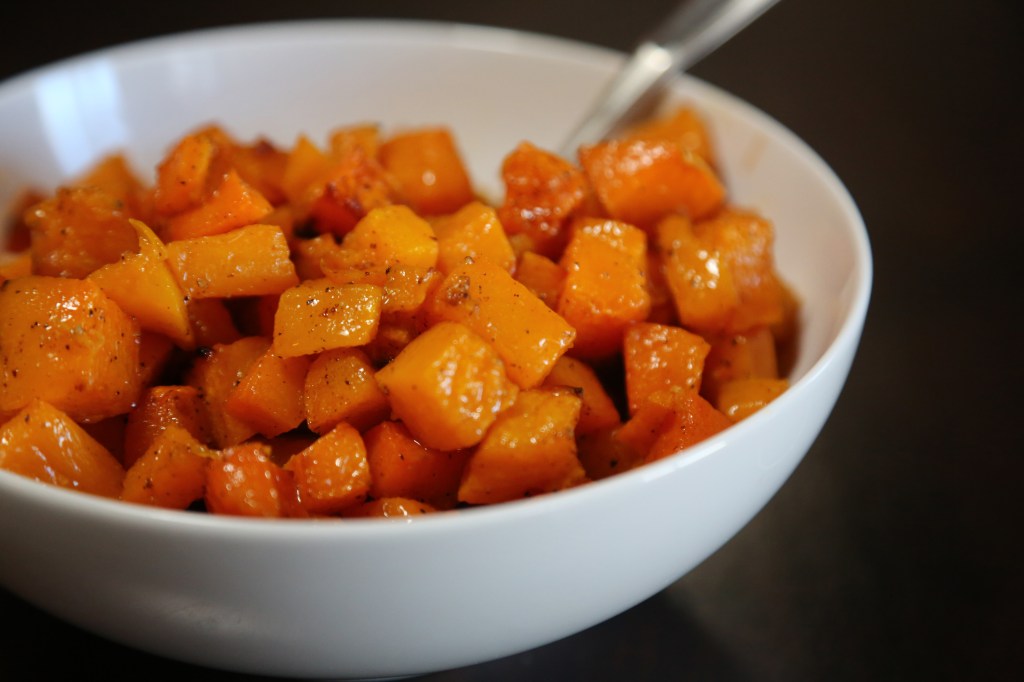
Every time someone asks me how to cook any vegetable, my answer will 99% of the time be: roast it.  Olive oil, salt, pepper, done.  That’s all you need.  I have discovered a new, refreshed love for so many vegetables by simply roasting them.  Butternut squash is one that benefits from this cooking method more than most.  As King of the Squash (a term I deemed it worthy) the butternut squash is more dense, less watery and has a deeper flavor than most squash.  In the winter months, it’s the most perfect side dish for any meal, and since it can be pureed beautifully or left in small chunks, it is the perfect baby food for babies just starting out with solids, or graduating into finger foods.

I found the easiest way to cut up a butternut squash for this recipe is by cutting it into cross sections:

bns2

Once you scoop out all the seeds, begin cutting off the rind.  The rind so tough, no amount of cooking will really make it edible. I mean, it is edible, but it wouldn’t be enjoyable.

bns3

Once you get all the rind off, cube up the squash into about 1/2″ cubes.  It’s important to keep your cubes all the same size because when things are varying sizes, they cook at varying times, and it makes everything more difficult when trying to get dinner on the table to wait for a 1/3 of your squash to continue cooking.  So.  Be consistent in your chopping!

Now comes the easy part.  Spread out all the squash on a large, rimmed baking sheet and toss 2 tablespoons of oil till completely coated, and sprinkle with kosher salt and pepper.  Roast at 400 for 45 min to an hour.  I want to add that your baking sheet needs to be big enough so that your squash isn’t completely crowded and piled on top of each other.  I’ve roasted it that way and the squash just steams and you don’t get those nice, charred bits that add to the texture and depth of flavor of this dish.

bns4

So you want to bake it kind of past the point where you think you should.  I always wait till a few edge pieces look a little burnt.

When they’re out of the oven, immediately put them in a bowl to keep warm.  They’ll cool off pretty quick on the pan.  Now for the magic.  Take a tablespoon of butter (be generous, verging on two tablespoons) and put it on the stove on medium heat in a stainless steel pan.  Let the butter melt and swirl it around until the foam subsides.  Then, when it starts to smell rich and nutty and there are butter solids forming at the bottom of the pan (this is why you use stainless – you can’t see this happening in a black, non-stick pan) remove the butter from the heat, pour over your bowl of squash and sprinkle with cinnamon, Chinese 5 Spice, pumpkin pie spice – whatever strikes your mood!  My go-to is Vietnamese Cinnamon.

Let me tell you – this is magical stuff with the addition of the browned butter.  I deeply believe that butter in moderation like this is not only fine, but life-giving.  The richness of browned butter could make anyone feel like a king at the table.  Cooking for your family is all about making them feel loved, warmed and nurtured.  If you wanted to get creative, throw a sage leaf in with the butter while it’s browning. (By the way, that makes an amazing ravioli sauce)  And yes, I realize I’m putting a recipe that has browned butter under the category of “healthy meals.”  I’ll rant about that in another post, but let me just say that I think there’s a lot more to eating healthfully than counting calories.  And 1-2 tablespoons of fat (okay 3 counting the olive oil) is about a tablespoon of fat per serving.  We’re not going to kill anyone with those ratios. And we’ll have happy eaters!

bns1

When I cook for Olive, I don’t ever hold back on spices except for salt and extremely hot spice (and even then, I salt, just less than what I’d prefer, and I let her have a bit of something spicy to see if she likes it.)  She happily ate these little nuggets the entire time we ate.  So that meant a happy, quiet baby for nearly an hour of eating.  Is THAT motivation enough to make this for your baby?  If you have a baby who isn’t eating chunks yet, simply take about a half cup of the squash into a bowl, add a bit of low sodium chicken broth or water and puree with an immersion blender.  Add a bit more cinnamon or butter and you have an amazing puree for your little 4-6 month old!

Enjoy!  And don’t forget to let me know how it turns out.  I know I just basically wrote out the recipe, but I hate blogs who do that and then don’t put a straight-forward version down below for me to copy/paste.  So!

Roasted Butternut Squash with Browned Butter

1 butternut squash, 2-3 lbs
2 tablespoons olive oil
Kosher salt and fresh ground pepper to taste
1-2 tablespoons unsalted butter
Cinnamon or whatever spice you think sounds good!

Preheat your oven to 400.
Slice the butternut squash into 1″ cross sections.  Scoop out the seeds (I use a metal measuring spoon – they have sharper edges for scraping) and cut into 1/2″ cubes.
Arrange the squash on a large, rimmed baking sheet.  Drizzle with olive oil until thoroughly coated and then sprinkle with salt and pepper.
Roast in the oven until some pieces begin to brown, about an hour.  Check the cooking at 30 minutes and stir the squash around to ensure even baking.  I know my oven has hot spots and I assume yours does, too.
Once the squash is done roasting, place it in a bowl to keep warm.
In a small saute pan, heat butter over medium heat until foam subsides and brown bits start to form on the bottom of the pan.  You’ll want to swirl the pan a few times and really watch.  There’s a HUGE difference between browned butter and burnt butter and you don’t want the latter.  I think the whole process takes about 5 minutes, but it will vary so once you smell that intoxicating nuttiness, you’re done.
Pour butter over squash and adjust seasoning as you like.

Enjoy!  Serves 4 as a side dish.  Or package it all up into freezable portions for baby, if you can part with it.