Creamy Rice with Peas and Asparagus

pea asparagus rice

There is a beautiful quarterly cookbook/magazine called Canal House cooking.  It is founded by two friends who meet together every day to talk about what they had for dinner the night before, and then they get cooking.  They decided to start writing down their recipes and what resulted was this beautiful magazine book.  I like to try recipes out that are in season, and so I am currently going through their Spring issue.  And even though there aren’t a  lot of fresh peas in our produce bins, I know that they are currently in season somewhere out there in lands where it rains, so I felt this was still an appropriate recipe for an overcast May day.  Asparagus is also in season, so I added some chopped up that I had roasted a few nights before and it was a really excellent addition.  Canal House calls this dish Risi E Bisi  (rice and peas) and it’s just that simple.

This is an excellent dish for little ones.  The comfort of soft rice and cheese and the addition of greens and a dab of butter makes this dish all-inclusive. For smaller, toothless ones, this would be so simple to pulse a few times with an immersion blender!  Olive still doesn’t like asparagus, but I think I’ve only given it to her 5 times.  I’m going to try at least 15 more times before I determine that she does not, in fact, love asparagus.  I challenge any  mom out there to do the same!  Case in point: I had nearly determined that Olive didn’t like peas until I hadn’t given them to her for a week or so, and then tried again and she gobbled them up.  I realized that familiarity equals good for a child.  So if you make a wide variety of vegetables simply familiar to a child, the enthusiasm will soon follow.  I believe this with all my heart, even on days where Olive spits out anything green.  One day she won’t, and I’ll be glad I didn’t let her under-developed, under-exposed palate determine her food preferences!

green rice

Creamy Rice with Peas and Asparagus
serves 6

2 tbs extra virgin olive oil
4 tbs butter
1 onion, finely chopped
2 cups fresh peas (you could also use frozen, as I did and it turned out great)
salt
6 cups hot chicken or vegetable stock
1 1/2 cups arborio rice, or other short grain rice.  I didn’t have any on hand, so I used plain long grain white and it was just fine.
1/2 cup freshly grated parmigiano-reggiano
pepper to taste
1 bunch asparagus, roasted at 400 with olive oil, salt and pepper until tender

Heat the olive oil and 2 tbs of the butter together in a heavy medium pot over medium heat.  Add the onions and cook until soft and golden, 5-10 minutes.  Add the peas and season with salt.  Cook for a minute or two, then add 1 cup of the hot stock.

Cover the pot, reduce the heat to medium-low, and simmer the peas until they begin to soften, about 5 minutes.

Stir in the rice and 4 cups of the remaining hot stock. Cover the pot and adjust the heat to maintain a gentle boil.  Cook the rice, stirring occasionally, until tender, about 20 minutes.

Remove the pot from the heat and moisten the rice and peas (if needed and too thick) with the remaining cup of stock (I didn’t do this step – my rice didn’t absorb as much as arborio would have) Stir in the remaining 2 tbs of butter and half of the cheese.  Fold in the chopped, roasted asparagus if you want.  Season with salt and pepper and serve sprinkled with remaining cheese.

The Ultimate Meatball and Taking Food to a Friend

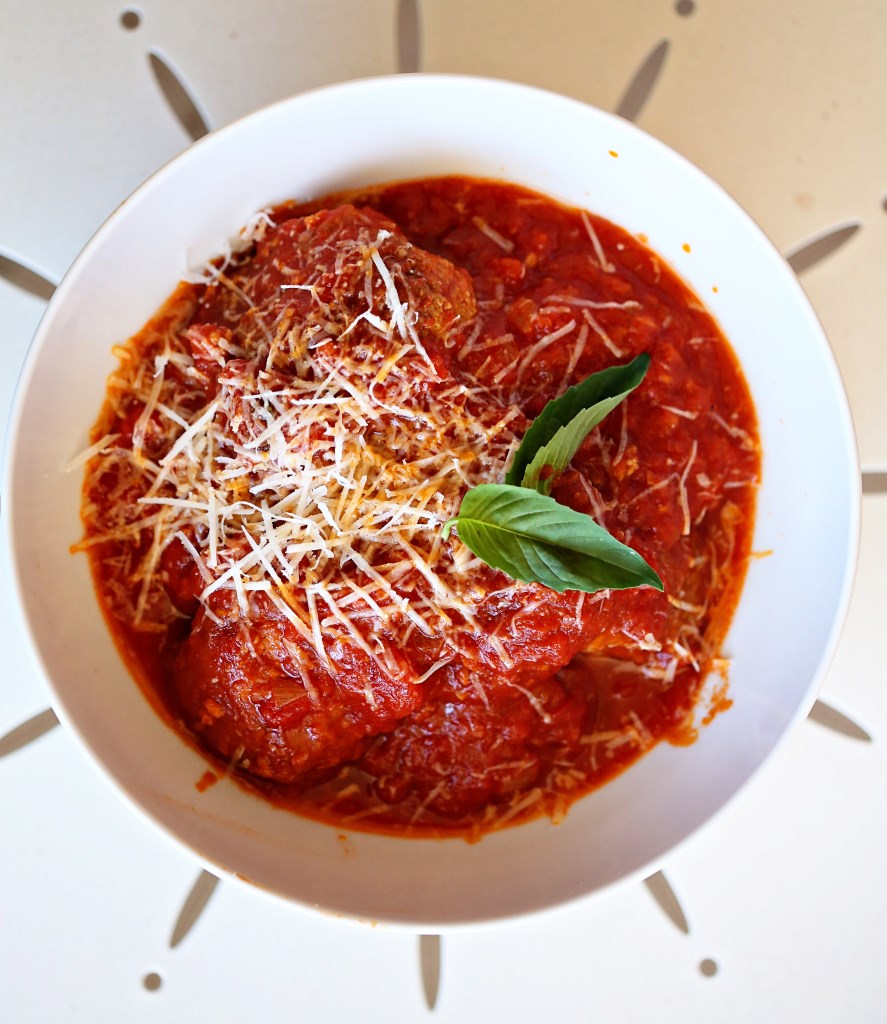
meatball and marinara

We’ve been on the receiving end of food donations twice in our life and both times, we were touched by others’ thoughtfulness, great recipes and the comfort that was passed to us through the dishes they made.  It takes a bit of humbling to bring food to someone who can’t cook for themselves, or simply don’t want to or don’t have the time.  You worry if they’ll like what you made.  You worry if they will critique the preparation or that you brought store-bought cookies instead of homemade.  If I could only convince you that anything you bring is wonderful and welcome, I would.  If they can’t eat it right away or they have duplicates, they can freeze what you brought!  To worry too much about what to bring, or to worry the recipient about what you brought, shifts the focus off the deserving and on to you.  Keep the focus where it belongs, ask if they have any requests or food allergies, and get cooking!  Homemade is always nice, but I will admit, I did not turn away store-bought cookies, chocolate or coffee! 🙂

My wonderful, life-long friend, Summer, had her second baby almost two weeks ago.  A beautiful, darling girl!  I immediately began to think of what I would bring for Summer and Phil to eat.  Summer is my food buddy.  I trust her cooking as much as my own.  Her sense of taste is far beyond most people, almost to a fault.  We used to live together in college, and I think one of our first food-bonding moments was throwing chicken patties off the balcony of our apartment because they were just so disgusting.  They were pre-cooked, breaded chicken patties and they tasted like…gray.  Or sweat.  It wasn’t good.  We both were actually offended.  How could you screw up a breaded piece of chicken, and worse, sell it to poor college students?! In our act of defiance against badly cooked food, we became unofficial food critics in our own right.  We were each other’s taste-testers. A favorite game throughout our friendship is Guess the Ingredient! in which we excitedly wait while the other tastes and see if they guess right.  I love that no matter what time of day, I can text Summer a description of something I made or want to make, and she will react with an appropriate amount of shock, enthusiasm and awe.

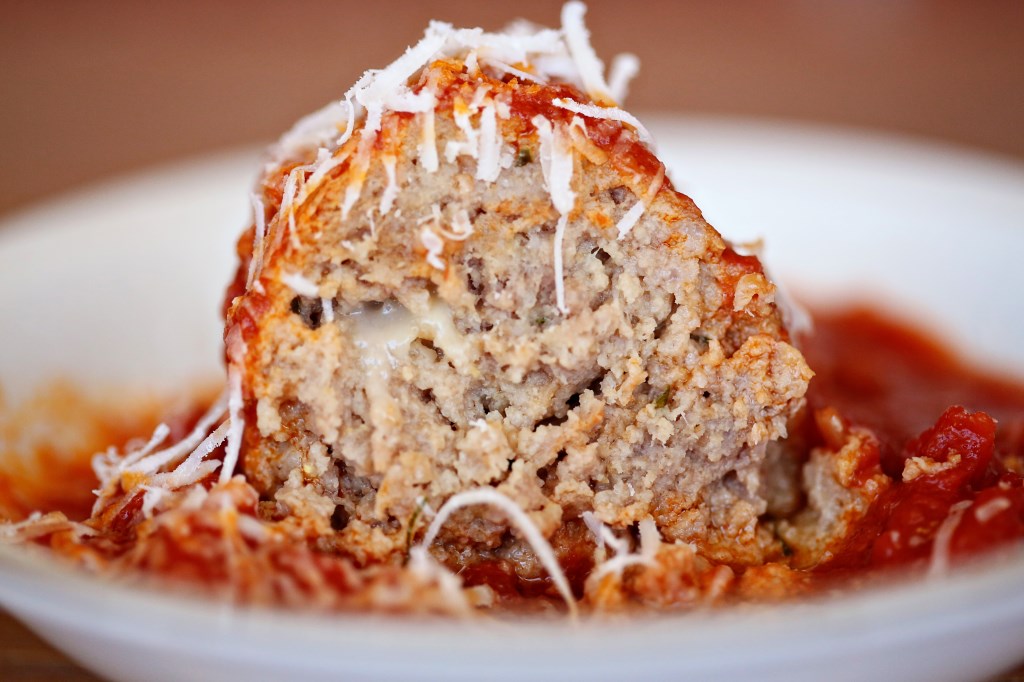
We joke that Summer always says her FAVORITE thing in the ENTIRE world is whatever I last cooked for her.  True to the accusation, I asked if she had any requests for what I could bring for them, and she requested the last meal I made for her, which was the BEST meatball recipe I’ve ever run across.  It’s tough to get a meatball right.  They can be too dry or too mealy or rubbery from being over cooked, or simply too greasy.  This recipe is perfect.  And even more perfect, it came to me via fashion designer, Michael Kors in his appearance on Martha Stewart Living.  So they’re both delicious AND fashionable.  Win-win.

The secret ingredient to these meatballs is the water.  Smooshing all these ingredients together, especially with the water, is not for the faint of heart.  My mother would die a thousand deaths before making this recipe.  She has a thing with texture.  However, I like playing with my food, so it’s rather enjoyable for me.  The meat mixture is very delicate, so be gentle as you turn them while cooking.  I usually use two spatulas to help me turn them without smashing them apart.  Getting a good crust on each side is key.  Then, there will still be a slight crust, even after they’ve stewed in the sauce for a while.  Oh, and serving this with spaghetti is up to you. It’s not tradition – the Italians eat their meatballs in a bowl with crusty bread.  But, the recipe makes enough sauce that even after we finish up the meatballs, I have plenty of sauce left to toss with noodles the next day.  Olive absolutely adores these.  She ate two, 3 inch meatballs by herself before slowing down.  They are so soft, you could easily smash it up for a little one.  And they get better the next day!

meatball

Frankie’s Meatballs in Rao’s Marinara Sauce

  • 1 pound lean ground beef
  • 1 pound ground pork
  • 1 1/2 cloves garlic
  • 2 large eggs
  • 1 cup freshly grated Pecorino Romano cheese
  • 1 1/2 tablespoons chopped fresh Italian parsley
  • Coarse salt and freshly ground pepper
  • 2 cups plain dry bread crumbs
  • 2 cups water, room temperature
  • 1 cup olive oil
  1. In a large bowl, combine beef and pork using your hands. Mince 1/2 clove garlic and add to meat mixture along with the eggs, cheese, and parsley; season with salt and pepper. Continue mixing with your hand until well combined. Add bread crumbs and mix well. Add water, 1 cup at a time, and continue mixing until mixture is quite moist.
  2. Shape mixture into 2 1/2-to-3-inch balls. Heat oil in a large skillet over medium-high heat. Smash remaining clove of garlic with the back of a knife and add to skillet. Cook until lightly browned and fragrant, 1 to 2 minutes; remove with a slotted spoon and discard. Working in batches, add meatballs to skillet. Cook until browned and cooked through, turning, about 10 minutes. Drain on paper towels and serve immediately.
  3. Meanwhile, bring marinara sauce to a boil in a large nonreactive saucepan. Reduce heat to a simmer and add meatball. Let meatballs cook in sauce about 20 minutes; serve immediately with pasta, if desired.

Rao’s Marinara Sauce
Makes 7 cups

  • Four 28-ounce cans whole tomatoes with basil, preferably San Marzano
  • 1/2 cup olive oil
  • 6 tablespoons minced onion
  • 4 cloves garlic, peeled and minced
  • Coarse salt and freshly ground pepper
  • 12 leaves fresh basil, torn (optional)
  • Pinch of dried oregano
  1. Remove tomatoes from can and place in a large bowl, reserving juices. Crush tomatoes using your hands; remove and discard the hard core from stem end, and any skin and tough membrane; set aside. (Wear an apron and keep your hand submerged as you crush.  This is messy business, but kind of therapeutic  .)
  2. Place oil in a large, nonreactive saucepan over medium-low heat. Add onion, and cook until soft and just beginning to brown, about 3 minutes. Stir in garlic, and cook until softened, about 30 seconds. Stir in tomatoes and reserved juices; season with salt. Increase heat and bring to a boil. Immediately reduce heat to low and simmer until slightly thickened, about 1 hour.
  3. Stir in basil, if using, oregano, and season with pepper; continue cooking 1 minute more. Remove from heat and serve.

*Recipes taken directly from Martha Stewart Living.  They can not be improved upon.

frankie's meatsauce

Kale Paneer

7G9A1648

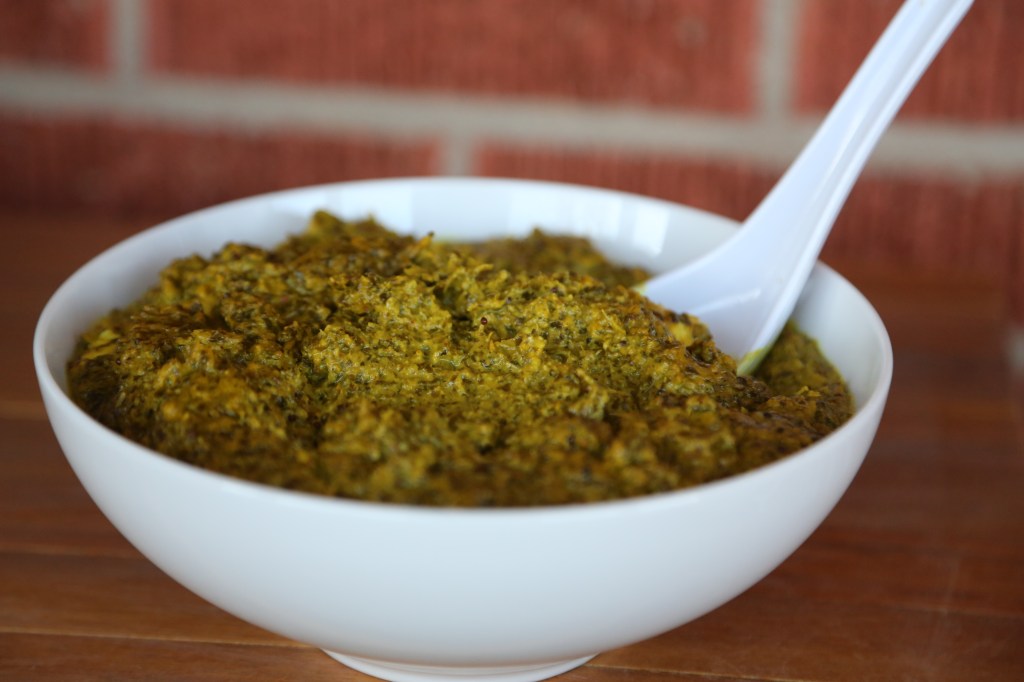
I received several requests for kale recipes when I asked a couple weeks ago for ideas for this blog.  I wanted to do something a little more challenging or interesting than the typical things you see for kale in the sea of Pinterest such as kale chips, kale salads, wilted kale, etc.  Basically, all the things you could use spinach for, if you were less ambitious.  I’m still not altogether familiar with kale’s flavor profile, but after turning a big bunch of it into creamy, soul-satisfying Indian food, I’m dedicated to finding ways to use this super food.

One of our favorite things to order at our local Indian restaurant is spinach paneer.  Creamy spinach with warm cubes of Indian cheese that doesn’t melt, but spreads wonderfully on a piece of garlic naan.  Truly a comfort food.  I saw this recipe for kale paneer and so I decided to try it for myself.  This girl calls for making a cream by boiling a cup of cashews soaked in hot water.  That sounded like a vegan move and I didn’t really want to buy a cup of cashews (hello, expensive) so I just subbed in  heavy cream, which I always seem to have on hand, and it turned out wonderful.  I also decided after tasting it that the cashews would have added a certain sweetness, so I added in two tablespoons of brown sugar and it was the right move – just enough sweetness to offset the bitterness of the kale and all the spices and it mellowed everything out really well.

For all of you who were wishing I’d do something a little more healthy with kale, like I said; there’s always next time.  But especially on this snowy day (wha?!) I think this recipe fits the bill.  If you lack the myriad of spices this recipe calls for, (I had them all! Proud moment) don’t waste your money at a regular grocery store.  Please go to Ghandi Bazar if you live in Lubbock, (or come to my house; seriously) and if you live elsewhere, I’m sure you can find an Indian market on some back street in your own town.  They know their spices and they’re cheaper than you’d EVER find at a chain grocery store.  Oh, and I didn’t go to Ghandi Bazar to find the paneer.  I was at United and looked up that Queso Blanco (or queso fresco) is very similar to paneer as it won’t melt and has very similar flavors.  It turned out great and got better with each day!

Kale Paneer*
1 medium yellow onion
2 – 3 Garlic Cloves
1 tbsp Minced Ginger
1 tbsp Sunflower or Canola oil
1 1/2 tsp Turmeric
1 1/2 tsp Ground Cumin
1 tsp Black Mustard Seeds
1 tsp Cumin Seeds
1/2 tsp Ground Coriander
1/2 tsp Garam Masala
1/4 – 1/2 tsp Ground Indian Chili Powder OR Cayenne (depending on how spicy you want it to be)
6 cups Chopped Curly Green Kale, packed
1 cup Plain Yogurt
1/4 cup heavy cream
2 tbs brown sugar
8 oz Paneer* OR Queso Blanco
Salt, to taste

Roughly chop the onion, garlic, and ginger. Heat a large pot over low-medium heat, add oil, then the onion, garlic, and ginger. Saute over low-medium heat until the onions begin to brown, at least 5 minutes. Once browned, add all of the spices and saute for another 1 or 2 minutes.
Add the chopped kale to the pot and saute until bright green.
Add the heavy cream to the kale mixture along with the yogurt and brown sugar, and stir in. Begin pureeing the curry with an immersion blender (or in batches in the regular blender) until smooth and no lumps remain, then transfer to a large bowl.
Once the entire curry has been pureed continue to cook over low heat, stirring occasionally.
Slice the cheese into small cubes and add to the simmering curry. Keep cooking, uncovered, stirring occasionally, until the curry thickens. If you prefer a thinner sauce, or you find the curry has gotten too thick, just add more water until it reaches your desired consistency. Season with salt, to taste, and more brown sugar, if necessary.

*recipe adapted from the adorable blog, Noms for the Poor (what a great name)

Baby Food – Creamed Spinach and Basil

spinach

Yesterday was one of those days when things just weren’t quite right.  I was getting over a stomach virus so I was getting nothing done and Olive refused to eat any part of a dish I cooked because it had peas (a dish she’s eaten before with much gusto), and thus, ate only orange foods and milk all day.  I really haven’t quite figured out days like that.  I try not to put too much thought into it and move on to the next meal, assuming she’ll eat more at dinner if she didn’t eat much at lunch and vice versa.  It’s hard to remember that babies aren’t little robots you can program as you like.  Some days I don’t feel like eating much for lunch, but I’m ravenous at dinner.  Some days I feel like bacon and eggs and toast and jam for breakfast and some days I’m just in the mood for coffee.  I only assume children are the same (maybe not the coffee part.)  I think it’s important in these seemingly picky-eating times to remain consistent.  Don’t start a bad habit just to get through a rough patch.  If through the picky days, we remain calm and smiling and say, “These two things are for lunch – take them or leave them” I think children will catch on a lot quicker that meal times are directed by mom and dad – and not by them.  A world where a baby dictates what we have for dinner – Lord, help us all…

Today was a little bit better.  Olive ate a two ounce portion of this spinach basil dish, and some leftover mango from yesterday – that was lunch!  Oh, and bits of our chicken, after we thought she had enough to eat 🙂

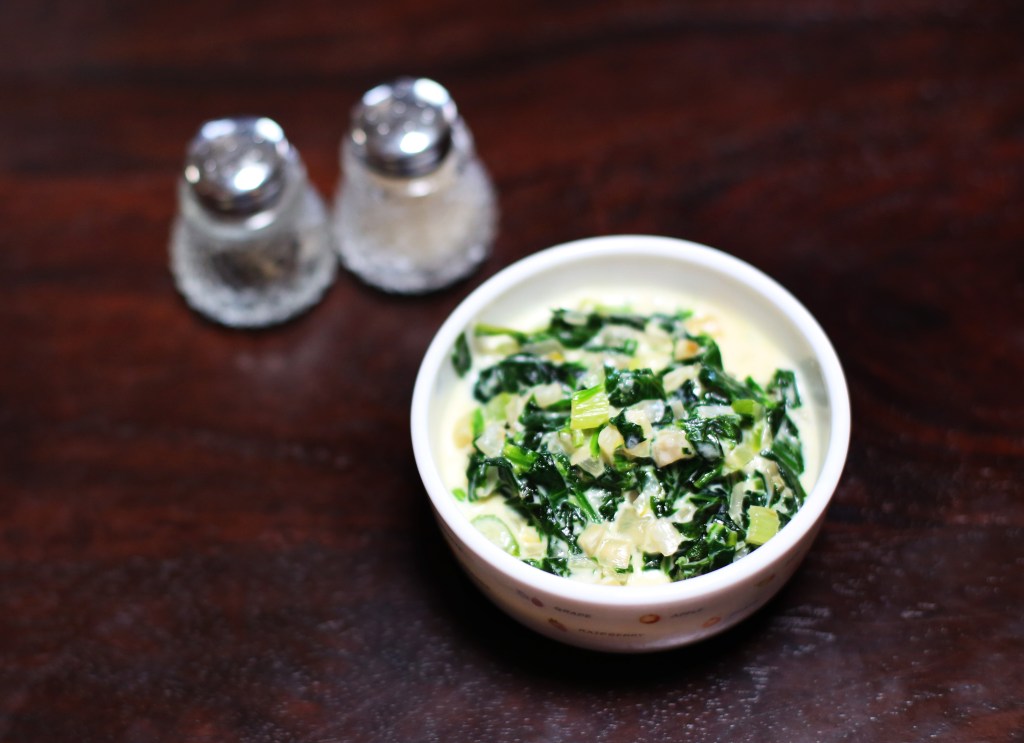
This is, by far, one of my favorite side dishes, and one of my favorite ways to cook/eat/enjoy spinach.  Matt and I found this recipe from watching an episode of Martha Stewart Living, where the great Jean-Georges Vongerichten cooked his amazing chicken and potatoes (where the potatoes are better than the chicken) and served this spinach on the side.  What a warm, comforting, indulgent family meal!  We have made both of these recipes multiple times over the past few years and each time, they feel new and exciting.  The spinach and basil would be absolutely perfect at Thanksgiving as a side dish.  There’s something about the basil that adds so much depth of flavor to the dish.  The cream helps with that, too…

Today, I didn’t have any fennel or serrano peppers, so I left them out of the original recipe, (which I highly recommend)  but I found it to still be wonderful and ideal for a baby in the 8 month and up range.  To make this for a baby just introduced to solids, simply blend with a couple tablespoons of water or chicken stock.

Creamed Spinach and Basil

serves 4 small portions.  Or 2 and a hungry baby

  • Coarse salt and freshly ground white pepper to taste
  • 3 cups tightly packed spinach leaves
  • 3 cups tightly packed basil leaves
  • 1 tablespoon olive oil
  • 4 tablespoons finely chopped shallots
  • 2 teaspoons finely chopped garlic
  • 3 tablespoons very finely chopped celery
  • 1 1/2 cups heavy cream
  1. Bring a large pot of salted water to a boil. Add spinach and basil and cook until wilted. Immediately transfer to an ice-water bath. Drain and squeeze dry; coarsely chop and set aside. (It looks like there’s hardly enough for one person – it spreads out and thickens up with the addition of the other ingredients, promise.)

  2. Heat oil in a medium skillet over medium-high heat. Add garlic and shallots and cook until golden. Add celery and continue cooking until soft and translucent.

  3. Add cream and let reduce until thickened, about 10 to 15 minutes. Add spinach and basil and stir to combine. Cook until warmed through. Season with salt and pepper; serve immediately.


Spinach and Basil 2


A little side note for any moms out there who might have a similar issue to me – Olive eats more…diligently…if she is holding something in her hand.  I am not a fan of letting her try to feed herself, yet, and letting her hold a toy is too distracting.  Most things are too distracting, but if we find that she can’t focus on the meal, I usually offer her one of her “salt and pepper” shakers.  She can hold them in her hands and it almost seems the instant she grabs one, she will happily take several more bites.  So, these are her salt and pepper shakers.  Filled with white and long grain black rice, respectively.  They make a nice shaking sound, the rice stays IN the container, and later, as she develops, she can even pretend to season her food.  Although we will certainly teach her to not season before she tastes, as a courtesy to the chef. 😉

spinach and basil 4


spinach and basil 3


7G9A0510

Bye-bye, Papa (said every day after lunch when he goes back to work – she’s going to be one tomorrow – how on earth did we get to this point?)


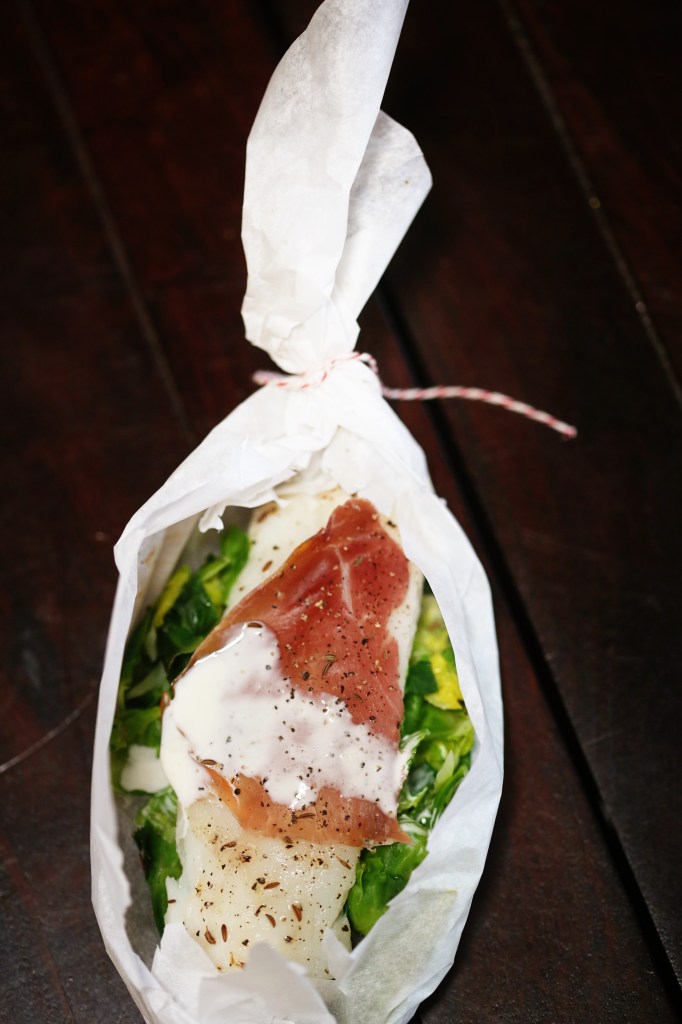
Cod with Brussels Sprouts and a Garlic Cream Sauce

codsprouts

I ran across a wonderful blog the other day that is an answer to a question I’d been asking myself since I first read Bringing up Bebe and French Kids Eat Everything.  What is a good example of a weekly menu that a typical Frenchie would have in their home, every day, WITH a baby?  Behold, the lovely blog, French Foodie Baby, written by a French woman who lives in L.A.  At the beginning of the week, she posts a menu of what they’ll be eating for lunch, snack (gouter) and dinner.  I love how adventurous she is with her cooking and while she has the luxury of living in a city with tons of markets and options, I have found that I can adapt the recipes pretty well for us.

French kids only have one snack per day and it’s usually at 4 p.m.  We’ve already started this habit in our house with Olive that she doesn’t eat anywhere but the table, and she only gets one snack around 3 or 4.  If she acts hungry 30 minutes before dinner, either Matt or I will go distract her in the other room by playing until dinner is ready.  She is usually quite hungry for lunch and dinner and does pretty well at restaurants because she’s hungry and will eat as long as we do (while turning 360’s in her high chair to check out the scene, of course.) As two moms at a restaurant pointed out the other night, “She’s been sitting here for an hour! Well, just wait till she’s two…”  Ah, the “just you wait” threat.  Moms give it to me on a weekly basis.  I am fully aware that a year old is way different than two, and that we will have to be extremely diligent in our efforts at mealtimes, but I’m confident that starting now, instead of at two, or whenever the eating issues arise, will make things much easier for us in the future.

This fish recipe was taken from the French Foodie Baby blog nearly word for word.  We enjoyed it very much, but I will warn that if this is the first time your baby has had roasted garlic, go easy.  (she suggests the baby be 8-10 months old for trying this for the first time.  We gave Olive’s portion a rough chop so they’d all be bite-sized pieces) Olive’s diaper the next day was…epic.  My fault.  She’d had plenty of garlic before, but maybe it was just too much?  Anyway, I would suggest straining out the garlic clove before preparing a small portion for your baby.

codsproutscream

Cod with Brussels Sprouts and Garlic Cream Sauce

Serves 4

1 lb Brussels sprouts

5 garlic cloves
1 1/4 cup heavy cream
1 lb cod fillets (this turned into two large filets for me, but I cut it down into 4 portions)
4 thin slices of pancetta (I had proscuitto in the fridge and it worked just fine)
4 pinches of caraway seeds
Salt & pepper
Preheat the oven at 350°F.
Bring a large pot of salted water to a boil. Quarter the Brussels sprouts and wash them. Plunge them in the boiling water for two minutes, drain them and cool them off under cold running water. Set them aside on a kitchen towel.
Wrap the garlic cloves (unpeeled) in parchment paper and bake them for 15 minutes.
Remove the skin and mash them with a fork. Combine with the heavy cream in a small saucepan and set aside.
Cut the cod into four pieces, and cut 4 squares of parchment papers.
On each square of paper, place a bed of Brussels sprouts, a piece of black cod and a slice of pancetta on top. Sprinkle with pepper and some caraway seeds.
Wrap the parcels and tie each end with kitchen string.  (Note: you can make these ahead of time and keep them in the fridge until ready to bake)
Place the four parcels directly on the bottom of the oven and bake 12-15 minutes.
Place the saucepan with the garlic and cream over low heat. Add a sprinkle of salt and some pepper. Bring to a low simmer.
Place each parcel on a plate, open it and pour the cream of garlic over the fish.
codsprouts finished

Chicken Pot Pies – for you and baby

cpp3

Making baby food purees is a really fun phase of having a new baby.  Whether you start them at 4 months or 6 months, you have about 3-6 months of making purees out of just about everything.  Over the past few months, I’ve pureed coconut curry soup, chicken fricassee, beef ragu – you name it.  I’d tote along little containers of food when we’d go out to restaurants and even had a waitress warm one up in the microwave, once.  (It was on the road, the restaurant was dead, we were her only table.) As much of an adventure as this was, I will admit that I’m excited that Olive can now pretty much eat what we eat, only chopped up a little smaller.  So, when we go out to a restaurant, we can order her a couple of side dishes and she’s happy!

However, I don’t want to start her out on the ugly road of “kid food” and “kids’ menus.”  Sure, they might be nice, smaller portions, but I bet none of us would have to try very hard to name at least five items on any kid’s menu at any restaurant in America.  1. Grilled Cheese 2. Hot Dogs 3. Pizza (cheese or pepperoni only) 4. Chicken nuggets with fries 5. Macaroni and Cheese.
Do you see a horrible trend?  Where on earth are the vegetables and why on earth do we pick the worst foods with the poorest nutritional value and label them as “kid friendly” choices and then give them to little, growing bodies?  This trend isn’t likely to improve any time soon, so in the meantime, I want to suggest a different kind of “kid friendly” choice.

Soups!

We were at Jason’s Deli a couple weeks ago and noticed that their kids’ menu is exactly the same, only with “organic” thrown into the mix and “whole wheat” to disguise the literally 100% meat, cheese and bread menu.  So we ordered her a chicken pot pie soup and she absolutely loved it.  I also noticed that she didn’t have any problem at all eating the whole peas, where as at home, she began refusing pea puree.  I had a side of tomato basil soup and she loved that, too.  I will state right now before everyone chimes in, that I realize these soups are probably high in sodium.  Most soups are.  But let’s look back at the alternative kids’ choices for a minute…

I came home from Jason’s that night with a new thought for what to cook for Olive.  Grown up soups that I don’t have to puree!  I naturally looked through the cookbook I’ve been addicted to lately, the Bonne Femme Cookbook, and found a wonderful sounding Poulet Pot Pie.  The lovely author herself, Wini Moranville, commented on my post last week that I should try it (leaving out the cognac, of course, although I will be trying the grown-up version very soon.)  I absolutely loved the flavors in this recipe – the fresh tarragon and leeks were my favorite part, and Olive happily eats it without slowing down!   This is much less “soupy” than what you might be used to, but I think for a baby in the “I have a few teeth, now” phase, I think it’s perfect.  You could also improvise with adding in other, small-dice sized vegetables of your choice.

Poulet Pot Pie – for the whole family

4-6 servings

  • 1 sheet puff pastry
  • 2 cups cubed rotisserie chicken
  • 4 medium-sized carrots, peeled and cut into 1/2″ dice
  • 5 tablespoons unsalted butter
  • 4 medium-size leeks, halved lengthwise, rinsed, and thinly sliced crosswise (white and pale green parts only) about 2 cups
  • 1 small yellow onion, chopped (about 1/3 cup. Everything is bigger in Texas, I found. Our “small” onions are probably France’s “ginormous” onions, so just measure out 1/3 of a cup and put the other 2/3 cup in a plastic bag. I did exactly that, with exactly those measurements.  And it was the smallest onion I could find)
  • 2 garlic cloves, minced (if you don’t own a Microplane, you really should get one for anything minced.  I use mine constantly for cheese, ginger, garlic, etc.)
  • 1/3 cup all-purpose flour
  • 1 cup low-sodium chicken broth
  • 1/2 cup 2% or whole milk
  • 1/2 cup heavy cream
  • 1 tablespoon fresh tarragon, or 1/2 teaspoon dried tarragon, crushed and 1 tablespoon fresh parsley
  • Fresh ground black pepper and kosher salt, to taste

Thaw puff pastry according to package directions, set aside.
Place cubed up chicken in a large mixing bowl.
Preheat the oven to 400F
Bring a 2 quart saucepan of salted water to a boil.  Add the carrots, bring back to a boil and cook for 3 minutes.  Drain, rinse under cold water and drain again.  Add to the chicken in the bowl.
Melt the butter in a large saucepan over medium heat.  Add the leeks and onion and cook, stirring, until the onion is tender, but not brown, 4 to 5 minutes.  Add the garlic and cook, stirring, until fragrant, about 30 seconds more.  Stir in the flour, making sure all of the flour is moistened by the butter in the pan.  Cook and stir for 1 minutes.  Do not allow the flour mixture to brown.  Whisk in the chicken broth and milk.  Cook and stir until thickened and bubbly; cook and stir 1 minute more.  Stir in the cream.  Stir in the chicken and carrots, the tarragon, and salt and pepper.  Bring mixture to a boil, stirring occasionally.
You would then transfer the entire thing to a 2-quart casserole at this point, but I used little 4 oz ramekins and had enough leftover after filling up 6 ramekins to fill a large souffle dish for Matt and I to split.

cpp2

Look at all the pretty colors!

I used a large cookie cutter and cut out the puff pastry and placed it over the ramekins and sprayed the tops with olive oil cooking spray.  I put plastic wrap and then tin foil over the tops and froze 4 and then put two in the fridge.  To cook, I simply let the dish come to room temp from the fridge and baked at 400 until the puff pastry was nicely browned and the insides were bubbling, about 20 minutes.
cpp1

Enjoy exploring new soups for the family and for your new, little eaters!  If you want to check out my Pinterest Baby Food board for more ideas, you’ll find it’s just mostly good-looking soups 🙂 Remember: there’s no such thing as kid food!  It’s all food and it’s all good for everyone!

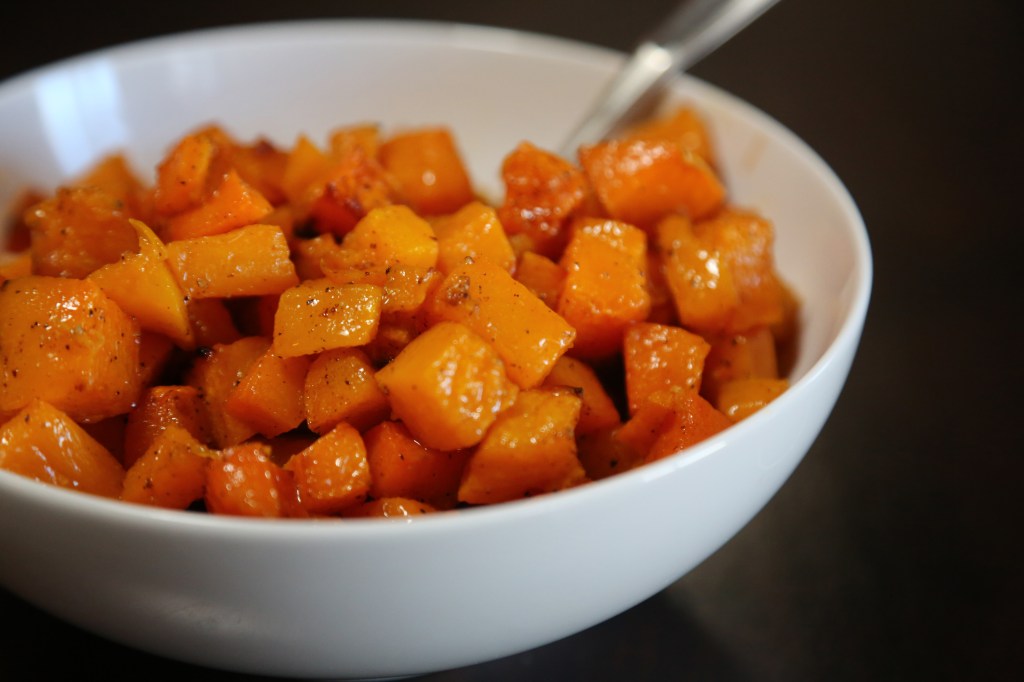
Roasted Butternut Squash with Brown Butter

Every time someone asks me how to cook any vegetable, my answer will 99% of the time be: roast it.  Olive oil, salt, pepper, done.  That’s all you need.  I have discovered a new, refreshed love for so many vegetables by simply roasting them.  Butternut squash is one that benefits from this cooking method more than most.  As King of the Squash (a term I deemed it worthy) the butternut squash is more dense, less watery and has a deeper flavor than most squash.  In the winter months, it’s the most perfect side dish for any meal, and since it can be pureed beautifully or left in small chunks, it is the perfect baby food for babies just starting out with solids, or graduating into finger foods.

I found the easiest way to cut up a butternut squash for this recipe is by cutting it into cross sections:

bns2

Once you scoop out all the seeds, begin cutting off the rind.  The rind so tough, no amount of cooking will really make it edible. I mean, it is edible, but it wouldn’t be enjoyable.

bns3

Once you get all the rind off, cube up the squash into about 1/2″ cubes.  It’s important to keep your cubes all the same size because when things are varying sizes, they cook at varying times, and it makes everything more difficult when trying to get dinner on the table to wait for a 1/3 of your squash to continue cooking.  So.  Be consistent in your chopping!

Now comes the easy part.  Spread out all the squash on a large, rimmed baking sheet and toss 2 tablespoons of oil till completely coated, and sprinkle with kosher salt and pepper.  Roast at 400 for 45 min to an hour.  I want to add that your baking sheet needs to be big enough so that your squash isn’t completely crowded and piled on top of each other.  I’ve roasted it that way and the squash just steams and you don’t get those nice, charred bits that add to the texture and depth of flavor of this dish.

bns4

So you want to bake it kind of past the point where you think you should.  I always wait till a few edge pieces look a little burnt.

When they’re out of the oven, immediately put them in a bowl to keep warm.  They’ll cool off pretty quick on the pan.  Now for the magic.  Take a tablespoon of butter (be generous, verging on two tablespoons) and put it on the stove on medium heat in a stainless steel pan.  Let the butter melt and swirl it around until the foam subsides.  Then, when it starts to smell rich and nutty and there are butter solids forming at the bottom of the pan (this is why you use stainless – you can’t see this happening in a black, non-stick pan) remove the butter from the heat, pour over your bowl of squash and sprinkle with cinnamon, Chinese 5 Spice, pumpkin pie spice – whatever strikes your mood!  My go-to is Vietnamese Cinnamon.

Let me tell you – this is magical stuff with the addition of the browned butter.  I deeply believe that butter in moderation like this is not only fine, but life-giving.  The richness of browned butter could make anyone feel like a king at the table.  Cooking for your family is all about making them feel loved, warmed and nurtured.  If you wanted to get creative, throw a sage leaf in with the butter while it’s browning. (By the way, that makes an amazing ravioli sauce)  And yes, I realize I’m putting a recipe that has browned butter under the category of “healthy meals.”  I’ll rant about that in another post, but let me just say that I think there’s a lot more to eating healthfully than counting calories.  And 1-2 tablespoons of fat (okay 3 counting the olive oil) is about a tablespoon of fat per serving.  We’re not going to kill anyone with those ratios. And we’ll have happy eaters!

bns1

When I cook for Olive, I don’t ever hold back on spices except for salt and extremely hot spice (and even then, I salt, just less than what I’d prefer, and I let her have a bit of something spicy to see if she likes it.)  She happily ate these little nuggets the entire time we ate.  So that meant a happy, quiet baby for nearly an hour of eating.  Is THAT motivation enough to make this for your baby?  If you have a baby who isn’t eating chunks yet, simply take about a half cup of the squash into a bowl, add a bit of low sodium chicken broth or water and puree with an immersion blender.  Add a bit more cinnamon or butter and you have an amazing puree for your little 4-6 month old!

Enjoy!  And don’t forget to let me know how it turns out.  I know I just basically wrote out the recipe, but I hate blogs who do that and then don’t put a straight-forward version down below for me to copy/paste.  So!

Roasted Butternut Squash with Browned Butter

1 butternut squash, 2-3 lbs
2 tablespoons olive oil
Kosher salt and fresh ground pepper to taste
1-2 tablespoons unsalted butter
Cinnamon or whatever spice you think sounds good!

Preheat your oven to 400.
Slice the butternut squash into 1″ cross sections.  Scoop out the seeds (I use a metal measuring spoon – they have sharper edges for scraping) and cut into 1/2″ cubes.
Arrange the squash on a large, rimmed baking sheet.  Drizzle with olive oil until thoroughly coated and then sprinkle with salt and pepper.
Roast in the oven until some pieces begin to brown, about an hour.  Check the cooking at 30 minutes and stir the squash around to ensure even baking.  I know my oven has hot spots and I assume yours does, too.
Once the squash is done roasting, place it in a bowl to keep warm.
In a small saute pan, heat butter over medium heat until foam subsides and brown bits start to form on the bottom of the pan.  You’ll want to swirl the pan a few times and really watch.  There’s a HUGE difference between browned butter and burnt butter and you don’t want the latter.  I think the whole process takes about 5 minutes, but it will vary so once you smell that intoxicating nuttiness, you’re done.
Pour butter over squash and adjust seasoning as you like.

Enjoy!  Serves 4 as a side dish.  Or package it all up into freezable portions for baby, if you can part with it.

Fruit Cobblers – cooking for baby

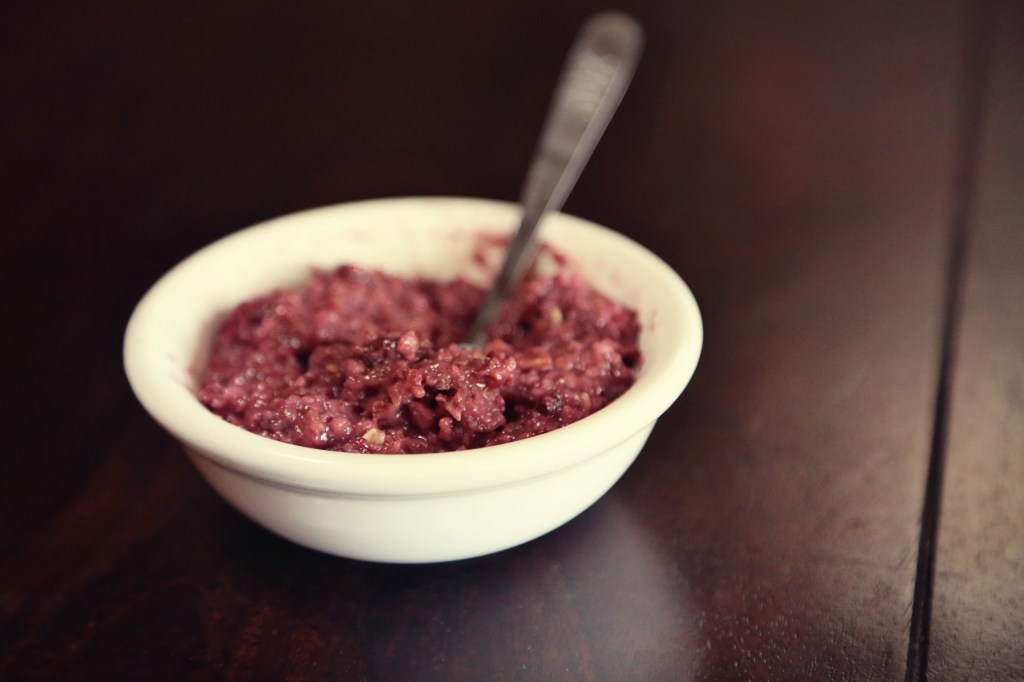
cherrybowl

One of my favorite things to make for Olive is various fruity “cobblers.”  During the winter months in this part of the country, the fruit that is in season is apples, pears, oranges, primarily.  I try my best to cook fresh produce that’s in season.  The biggest reason is obviously, freshness and quality.  But another BIG factor is price.  You think it’s too expensive to eat healthy?  That’s probably because you’re trying to buy berries in December, or fresh corn in February.  Fruits and vegetables in season just taste better, too.  The apples and pears this time of year are awesome.  And we’ve eaten plenty of them!  But it starts to get old and pretty soon I start eyeing those hot-house blueberries, tempted to pay the $4.99 just to have something different.

That’s where frozen fruit comes in to save the day.  Fruits that have been frozen are usually picked at the peak of ripeness and flash frozen.  This means really great, concentrated flavor.  So during the winter, if you’re planning on cooking the fruit anyway, buy frozen.  I really try to offer Olive something new every couple days, but the girl is well-versed in apples and pears.  So to branch out, I buy frozen bags of raspberries, blueberries, blackberries, mango, and I mix them with oatmeal or yogurts for a naturally sweetened treat.

Olive is not a fan of plain oatmeal.  But tell me, who is?!  So here’s what I do with the frozen fruit and this makes at least six- 2 ounce portions of baby food in one whack:

Fruit “Cobbler” 

One bag of frozen fruit (in this picture, I used black cherries)
2 tbs salted butter
1/2 cup rolled oats (I used Quaker Old Fashioned)
cinnamon
1/2tsp lemon juice

Empty the bag of frozen fruit into a large skillet.  I use my non-stick fry pan that’s about 10″ in diameter.  Turn the heat to medium and put the salted butter in with the fruit and let it all come up to a simmer.  I use salted butter in most things I make for Olive because I don’t add extra salt.  I find that it gives enough flavor while going easy on the salt intake.  I add a few dashes of cinnamon while it’s bubbling away, but really, you could add any spice you want – nutmeg, clove, orange peel.  Whatever you think would be good!  For that cobbler effect, a few squeezes of lemon juice really brings out the flavor of the fruit.  When the fruit has bubbled for a while and is thickening up a bit, I add about a half cup of oatmeal.  If it looks too thick, I add in some water.  Too thin, more oatmeal. But it’s rarely too thin. I don’t really let the oats cook, because I find that once they sit in the fruit and juices from the fruit and lemon, that they absorb and have the right consistency when you warm it up to serve after at least a day in the fridge or freezer.

I then transfer the mixture to a tall container and pulse it a few times with my immersion blender.  The immersion blender has made making baby food a breeze with minuscule clean up.  Then, I just transfer to 2 oz. containers and save one or two for the fridge and put the rest in the freezer.  Buying those cute little plastic baby food containers is fine, and I have a few sets of them and use them all the time (they’re great for taking in your purse to a restaurant!)  but I’ve found the easiest thing is to use a tin-foil muffin tin that can be found at any grocery store for about a dollar, and they are conveniently 2 ounce portions.  I just freeze the food in those, then pop them out, put them into a ziplock bag and done!

I’ve made this recipe with blackberries, raspberries, blueberry banana (the best ever that I may or may not have eaten myself), black cherry, mango, pear and apple.  I’m addicted to the simplicity, the variety and knowing that Olive is getting good stuff and trying something new.  I have also cooked down fruit and mixed it in with plain, full fat yogurt.  She loves it all, so far!

olive-ten-months

As you can see, she is serious when it comes to eating.

cherry cobbler