Zucchini Bruschetta – Hold Off on Cardigans a Little Longer…

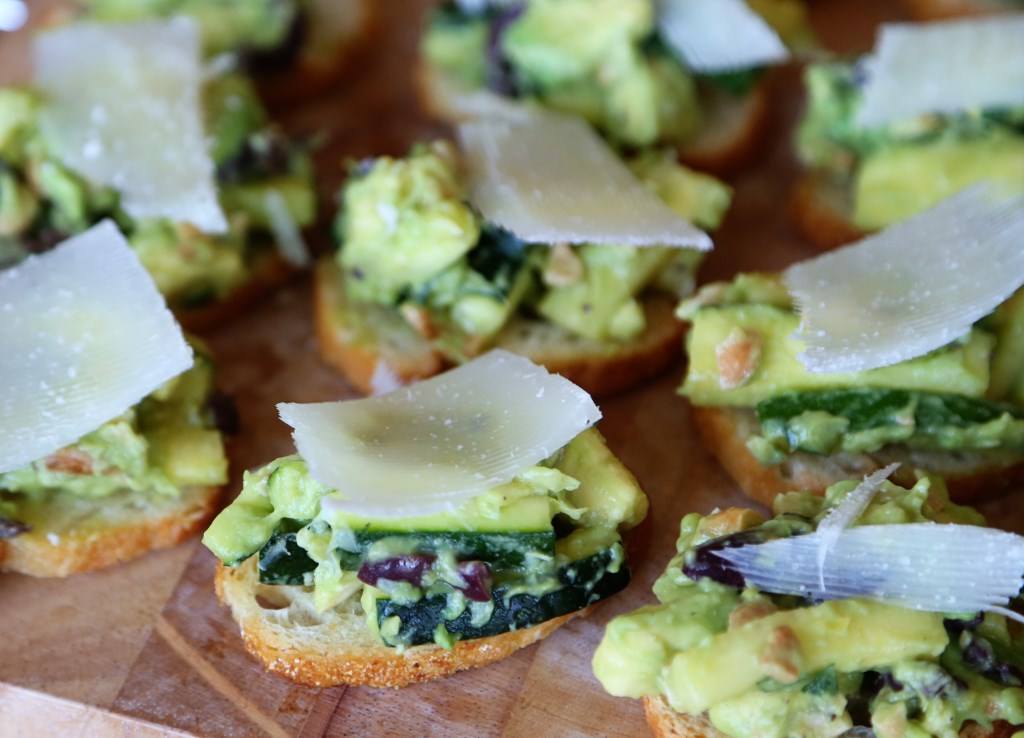
Zucchini Bruschetta detail

The summer seems to be winding down, although I wouldn’t be surprised if we had 100 degree days well into October.  I’m getting in that cozy fall mood, already, though, and it’s dangerous because I want to wear cardigans and listen to jazz and eat pumpkin flavored things and it’s still 98 and muggy outside.  Sometimes if the summer goes on a little too long, I start protesting by wearing my sweaters, regardless of the temp.  I consider it my adult fussypants-ness.  Everyone’s got a cross to bear – mine is shorts-weather.

This recipe keeps me mildly okay with the fact that it’s still summer.  It’s so fresh and happy and has such bright, bold flavors and colors that it makes the perfect appetizer when your friends are keeping you company in the kitchen as you finish roasting the pig…or whatever it is you cook for your friends.  This is also a great way to use up the only thing you got to grow in your garden, this year.  What is it about zucchini?  Why does it:
1. Always grow
2. Grows as big as a Great Dane
3. Give you more yield than any one family could ever consume?

Zucchini gives false hope.  “Hey, you can grow me!  Now let’s see how you do with carrots!  Go on!  I want to see you try!  Loser.”

Or that’s how my zucchini plant makes ME feel…

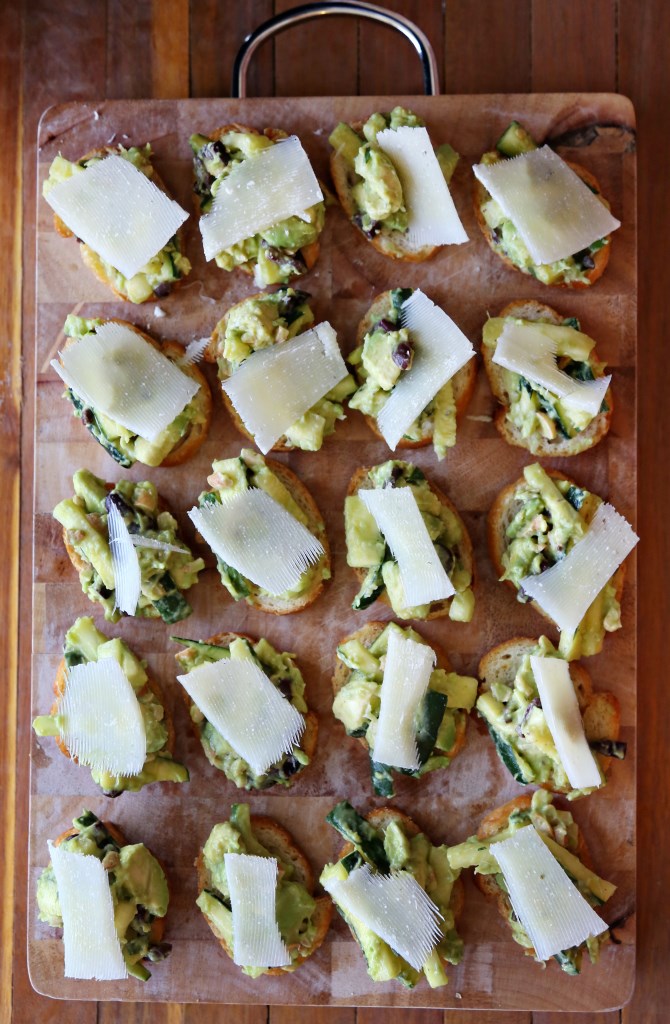
zucchini bruschetta appetizers

Zucchini and Olive Bruschetta*
serves 6-8 appetizer sized portions

1 baguette, cut into 1/4″ slices
2 tbs olive oil, plus more for drizzling
4 small zucchini (about 12 ounces)
1 large avocado (ripe, duh)
zest and juice from one lemon
12 large mint leaves, chopped
1/3 cup toasted almonds or any nut, really
1/3 cup chopped catamala olives, or whatever floats your boat
2 ounces pecorino romano, parmesan or other firm cheese you enjoy

Heat oven to 375°F and arrange a rack in the middle.  Slice zucchini lengthwise into 1/3” slices and then stack the slices and cut into 1/3 “ matchsticks lengthwise. Once all the zucchini are sliced, cut them lengthwise into 1” pieces.

Place the zucchini in a colander and toss with ½ teaspoon of kosher salt, and set aside to drain for 20 minutes. Meanwhile, brush the bread on both sides with olive oil. Place on a baking sheet and bake until crusty and brown, about 10 to 12 minutes. Turn once halfway through to toast evenly. Remove and cool.

Peel and pit avocado then cut into 1/2-inch dice. Place in a medium bowl and toss with lemon juice and zest. Roughly chop mint leaves and add to avocados.

Line a large plate with paper towels and spread out salted zucchini. Lay another layer of paper towels on top and pat off excess moisture. Add to the avocado bowl along with the almonds and olives and mix thoroughly. Taste and adjust salt to your liking.

Top each crostini with a heaping spoonful of the zucchini mixture. Drizzle over olive oil and fresh cracked pepper. Using a peeler thinly shave cheese and top each crostini with a few slices and serve.

*recipe adapted from aidamollenkamp.com

Beautiful Beets and Second Chances

beets008

This is a perfect Monday post because no one really reads my Monday posts so I can be as nerdy as I want.  Here it comes…

beets012 beets013 beets006

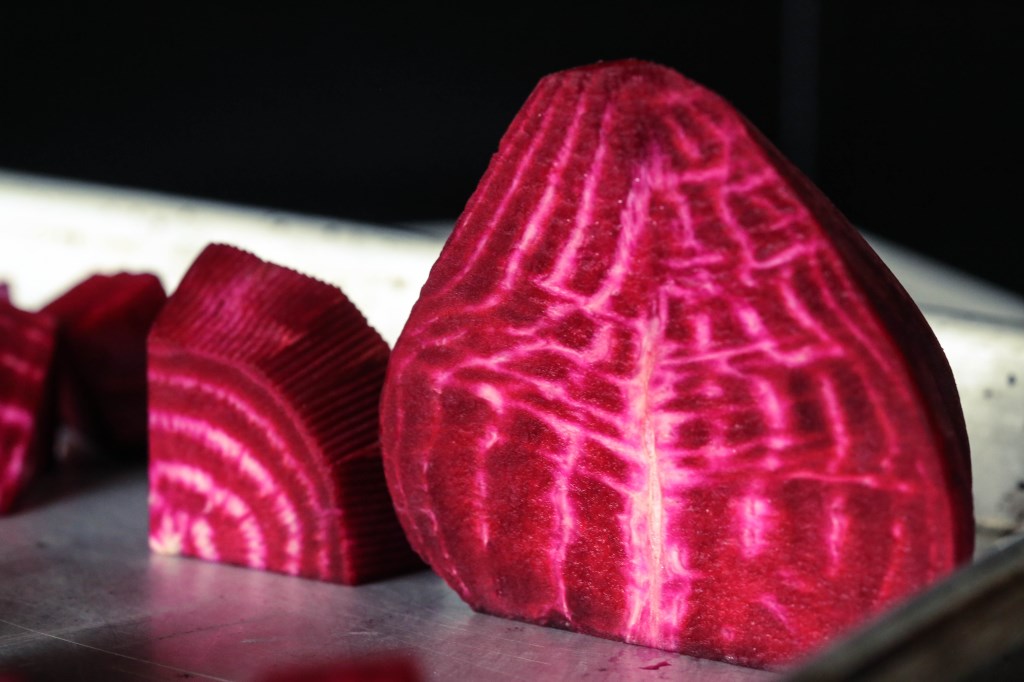
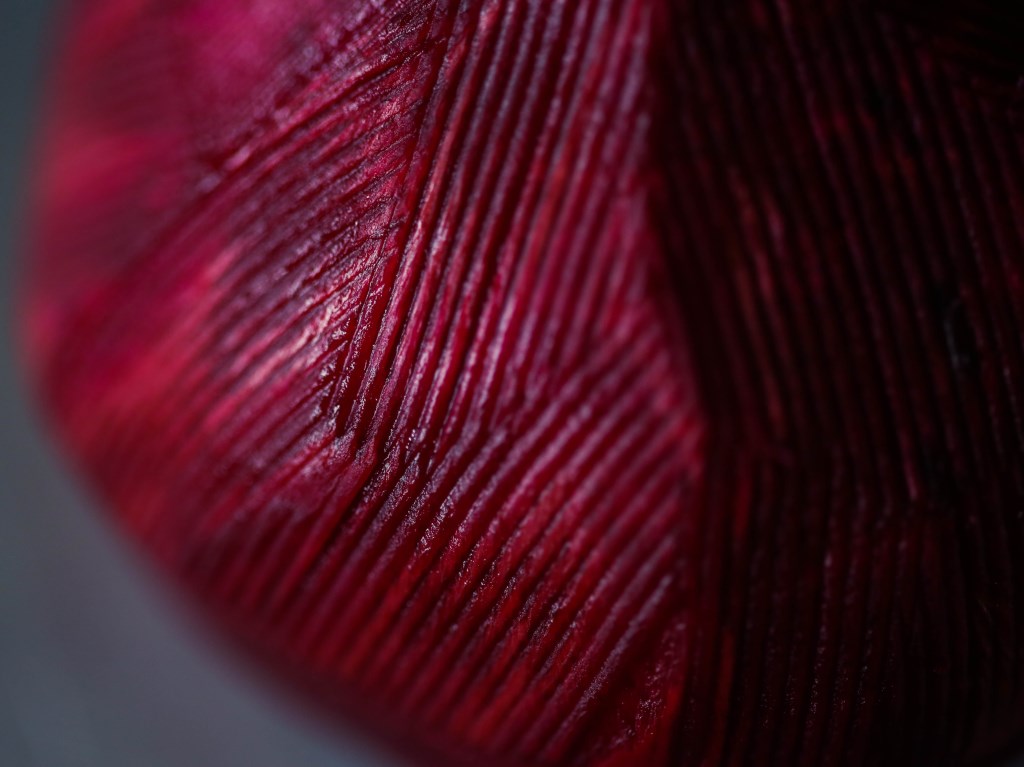
I took a lot of pictures of beets the other today.  They’re beautiful.  Why aren’t they more popular in this country?  A PINK food?  Come on! Kids should be all over these.  They stain worse than food coloring.  They roast up sweet and savory.  I think a lot of people in this country have been scarred by canned or pickled beets.  That’s the taste they have in their minds.  I can understand why that wouldn’t be the most appealing taste memory.  But think about this – what if someone decided a long time ago that the best way to eat a potato would be to brine it?  Everyone would say, “Eww, potatoes.”  THINK ABOUT THAT!  So, my determination is to try previously unappealing foods in different ways than they are known for.  Roasting is almost always the best way to cook a root vegetable.  It works with just about anything from asparagus to parsnips to turnips.  It’s good to give foods with a bad reputation a  second chance. You never know if you’re one recipe away from your new favorite food.

This post is really just for showing the pics I took of beets.  And if you are curious, peel them, chop them into cubes, coat them in olive oil, sprinkle with salt and pepper and roast them for 30 minutes at 400F until tender.  No brainer.

beets002 beets003 beets004 beets007 beets001 beets015
Ready for roasting

My family looking at me as if I’d gone crazy while I took pictures of beets for 30 minutes.
beets014


Cajun Shrimp and Potato Bake

shrimp and potatoes002

This is a fantastically easy, hearty, well-rounded meal that is wonderful for the whole family.  I love cutting corn cobs into sundials – it’s not only very pretty to look at, but it makes it very easy for little hands to pick up and dig in!  I created this meal after determining we had nothing to eat 🙂  I had a few fingerling potatoes, 3 cobs of corn, and about 12 shrimp in the freezer.  Oh, and a shallot.  I had a shallot.  It really is remarkable what you can create when your laziness for going to the store beats out your laziness for cooking.  I chopped up everything, roasted them, and served it all in bowls with plenty of hot sauce!

This meal was made possible by the previously stated freezer staple, frozen shrimp, and a strong desire to stay home and out of the heat.  We had leftovers for a few days from this, and for what was probably $5 total, I’d consider that a success.

shrimp and potatoes004

Cajun Shrimp and Potato Bake
serves 4

1 lb fingerling potatoes, or small, new potatoes, chopped into 1″ pieces
3 cobs of corn, cut into 1″ cross-sections
1 large shallot, or 1/2 a medium onion, cut into thin half-moons
1/2 lb peeled, deveined, frozen shrimp (about 6-8 per person, if they are big)
1 tsp Cajun seasoning (or Old Bay would work great)
Olive oil (about 3-4 tablespoons total)
Kosher salt and fresh cracked pepper

Preheat the oven to 375. Run cold water over the frozen shrimp to thaw and leave it in the colander while you cut up the vegetables.  Toss the potatoes, corn and onion with about 2 tablespoons of the olive oil and sprinkle well with salt and pepper.  Roast for 25-30 minutes, until corn turns golden and potatoes are tender, stirring once or twice during cooking time.  While the vegetables are roasting, rinse the shrimp again and then lay them out on paper towels, blot dry and sprinkle with salt and pepper and Cajun seasoning on both sides.

When the vegetables are almost done, take the tray out and lay the shrimp on top of the vegetables and drizzle with olive oil.  Bake for 10 minutes, or until the shrimp are opaque.  Toss everything together in a big bowl and serve with hot sauce of choice!

Figs with Cream and Honey

figs and honey
Fresh figs are exceptionally hard to find around here.  I’m not exactly sure, why, because our climate is perfect for the fig plant.  Maybe I’m just going to the store at the wrong time of day.  Maybe some old lady waits till she sees the truck and loads up the back of her Cadillac so she can make jam.  Whatever the reason, I’ve never had much luck finding them.  Most that we can find are dried and the fresh ones are crazy expensive.  So when I happened to pass these by, I got really excited.  I got some from a friend a few years ago and made some killer port wine figpote, but I’d never just given the fig a chance to be eaten plain without dumping a bunch of sugar on it.  (I know – I dumped honey on it.  But not a lot, really.  And it seems okay when it’s not white sugar by the cupfuls in a huge jam pot.)

These figs are currently at Market Street and they are beautifully ripe.  A fig is nearly an instant dessert without doing any fancy prep to it.  It has such a luscious texture and the flavor is mellow and pairs well with so many things.  So, with just a little work, you can escalate a simple fig into a high-end dessert you might get charged $12 for at a restaurant that claims to be “up-scale.”  Not to mention, it’s wonderfully easy for a baby or toddler to eat, and it goes so well with wine, you might just feel like it’s the weekend in the middle of the week.  Desserts can do that.  And because this is a very sensible dessert, I’m giving you permission to eat it on a Tuesday, instead of waiting for the weekend.

figs with creme fraiche

Figs with Cream and Honey
serves two

4-6 fresh figs, depending on size
1/4 cup creme fraiche
1 tbs honey, plus more for drizzling
2 tbs roasted, salted pistachios

So, basically, the ingredients are the instructions.  Wash the figs, slice them down the middle and remove the stems.  Arrange them on a plate and whip up the creme fraiche with the honey until smooth and place in the center of the figs.  Top the creme fraiche with the pistachios and drizzle the whole thing with extra honey and serve!  Creme fraiche can be replaced by greek yogurt, fresh whipped creme, or even marscapone cheese.  The pistachios were a last minute addition but they totally brought everything together and added real depth to the dish.  In the tone of James Oseland, I give this dish 3 and a half starrrrrrs.

figs with creme fraiche, honey and pistachios

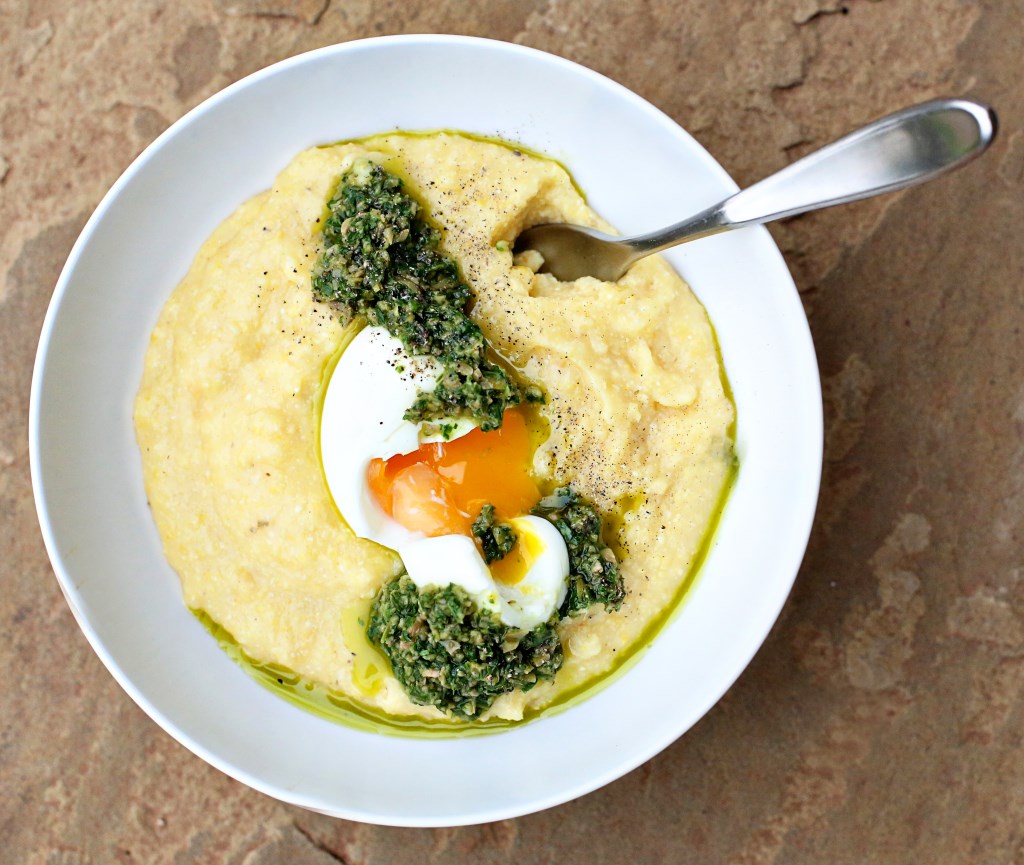
Cheesy Grits with Olive Pesto and a Soft-Boiled Egg

Cheesy Grits with Olive Pesto and a Poached Egg

Grits, Polenta, Cornmeal – whatever you call it and however you prepare it, it can take on many forms and flavors.  To us, slow-cooked grits is about as comfy as comfort food gets.  When done right, grits can be amazing.  Too often, people associate grits with the translucent, gel-like, flavorless substance they encounter at cheap breakfast houses the world over.  I often say that if you don’t like a particular food, you might have just had a bad version. I was this way with grits, apple pie, turnips, pork chops, just to name a few.  When I had a GOOD bowl of cheesy, smooth grits, I was hooked.  When I had an apple pie that was distinctly apple and had a good, buttery crust and wasn’t watery, I understood the appeal.  Sometimes you just have to give a dish a few tries before putting it in the “dislike” category.

This recipe for grits is one of my favorites, so far.  This basic, creamy grit recipe stays the same – just the toppings change.  This makes it one of the easiest weeknight meals to prepare because the grits cook for about an hour, which you inadvertently stir while you’re doing other things.  Then, when it’s time for dinner, you just spoon out helpings, add toppings of choice, and dig in.  I honestly think that it’s a healthy meal, too, because the grits are cooked with chicken stock and you don’t even have to add cheese for amazing depth of flavor, if you use good grits.  I use Lamb’s stone ground grits, (you can find these at United) and they are amazing.  Just a little seasoning and they are perfect.  So, the indulgence level is up to you with this beautiful, blank canvas!

I found a recipe for an olive pesto on this beautiful blog, and with the poached egg, she had me sold.  Only, I didn’t poach mine, I did a pretty fool-proof method of soft boiling the eggs, letting them cool, and then carefully peeling them.  Not so fresh eggs work best with this method.  I will post my own pesto recipe on this blog, soon, as I’ve made it quite frequently and it’s one of those things, like guacamole, that you should just know how to do and do well.  And by “well” I mean, keep it pure and simple!

Cheesy Grits with Poached Egg and Olive Pesto

Cheesy Grits with Olive Pesto and a Soft Boiled Egg*

For the Polenta:
2 cups stone ground grits (do NOT use instant grits)
8 cups water/chicken stock (I did half and half)
1/2 cup shredded Parmesan cheese, or any other hard cheese
Salt and Pepper to taste

Get the water and/or chicken stock boiling on the stove.  Gradually whisk in the grits, careful to break up all the clumps.  Lower the water to a simmer and stir, occasionally, for about an hour.  You can test to see if they need more cooking by tasting a bit for crunchiness.  Shouldn’t be too crunchy – think of it like cooking rice.  Stir in the cheese till it melts and adjust seasoning with salt and pepper.  Cover and set the burner on low and get on with your toppings.

For the Pesto:
1/3 cup olive oil
1/2 cup green olives, coarsely chopped
1 cup fresh basil
1/2 cup fresh oregano or marjoram (I discovered they are wickedly similar)
1/4 cup fresh thyme, coarsely chopped

Put all this stuff in a blender, food processor, or tall cup with an immersion blender and pulse till chunky and well combined.

For the Eggs:
1 egg per person, room temp (To make them room temp quickly, simply put them in lukewarm water for about 10 minutes)
a big ol’ pot of water
tablespoon of white vinegar
salt

Get a big pot boiling with water and salt it and add the vinegar.  Carefully lower the eggs into the boiling water.  Boil for 5 minutes.  Remove from the water and let them sit in lukewarm water till cool enough to handle.  Veeeerrrrrry carefully peel the eggs and set aside.

Assemble!

Spoon grits into each bowl (they may need to be stirred a bit from sitting there.  They form a skin, but it’s okay, it stirs back up just great) and top with a poached egg, a spoon of pesto and extra pepper.

*adapted from thekitchn.com

Rosemary Crusted Pork Chop with Coconut Milk Braised Carrots

Rosemary Pork and Carrots006

This is a good meal for many reasons.  The pork chops were actually a good thickness, and lean, and were buy one pack, get another pack for free (4 really thick chops in each package.  I get ridiculously excited for discounts in the meat department.)   I bought a 5 pound bag of carrots two weeks ago, and so I am currently looking for different ways to prepare them, and found a stunningly simple and flavorful way on one of my favorite blogs, French Foodie Baby.  Say what you will about my French obsession, but those people KNOW their food, and from a very loving depth that centers around family and love of pure ingredients.  Helene, from FFB, is one of the best writers in the myriad of food blogs out there. I literally exhale with relaxation when I read her posts.  She challenges me and inspires me and makes me want to be better at being thoughtful about what I put on the plate for my family.

The braised carrots in coconut milk was from her blog and I just took the concept and did it in a much bigger batch on my stove so that I’d have leftover finger foods for Olive for the week.  And so I could use up the never ending bag of carrots.  I swear that thing is multiplying.

I don’t know much, but I do know that pork and rosemary are best friends.  So when I saw that Helene put rosemary in with her coconut milk to braise the carrots, I thought: instant pan sauce!  And it turned out wonderful!  The extra sauce from the carrots made an amazing garnish for a thick, crispy, rosemary-infused pork chop!  I was happy with this meal and wanted to share its simplicity and comfort-food qualities with you today!

Rosemary Pork and Carrots002


Rosemary Pork and Carrots005

Rosemary Crusted Pork Chop with Coconut Milk Braised Carrots
serves 4-6

4 boneless pork chops, thick cut, if you can find them (the ones I found were about an inch thick)
1/4 cup flour
Salt and pepper – about a half teaspoon of each
2 tbs chopped fresh rosemary – I would think dried would be fine, but it wouldn’t be as aromatic
4 tbs butter or olive oil for pan frying the chops

For the carrots:
1 lb carrots, peeled and chopped into half inch rounds
1 can of coconut milk
2 cloves of garlic, crushed but left mostly in tact
two sprigs of fresh rosemary
salt and pepper to taste

Get the carrots on the stove to braise first, as they take the longest.  In a deep skillet, heat the coconut milk over medium heat along with the cloves of crushed garlic and the rosemary sprigs.  Add in the carrots and let it simmer on the stove until the carrots are tender, about 20 minutes.  I put a lid on halfway through as to not lose too much moisture.  When the carrots are done, remove the pan from the heat and set aside.

For the chops: pat them dry with paper towels and season both sides with salt and pepper.  Put the flour and rosemary and a few dashes more of salt and pepper in a bowl and toss well to combine.  Coat each side of the chops in the flour mixture and set aside.  Heat the butter or olive oil in a non-stick skillet over medium heat until shimmering (or bubbling if using butter) and add in the chops, cooking about 5-6 minutes per side.  If they are browning too quickly, reduce the heat after you get a good sear/crust on each side of the chop.  If your chops are really thick, you may need to transfer them to a preheated oven to finish cooking.  I had to do this for one of the chops because it was way bigger than the rest and wouldn’t cook through without burning the crust.  At any rate, you need a meat thermometer for this because we no longer have to cook our pork to death to be safe.  Some farmer told me that no one’s gotten sick from pork in years, but everyone is still cooking it like they could.  A pink center is fine – I made sure mine got up to 150-160 and called it good, regardless of how the centers looked.

Place the chops on plates and for the sauce garnish, move the carrots to a bowl, reserving about a 1/2 cup of the coconut milk in the pan.  Taste for salt and season as necessary.  Remove the rosemary sprigs and the cloves of garlic and spoon the sauce over each chop and serve alongside the carrots.  If you don’t cook the chops too much, they will be soft enough for a baby to chew, given she has at least 3 molars, which mine does.  She loved the carrots (she’s 15 months old) and ate a few pieces of pork and called it good.  And lately, that has to be good enough for me!  For smaller babies, the carrots would be IDEAL pureed or just left in tact for finger foods.  They are so soft, sweet and a little salty – perfect! I would have blended up the pork with some coconut milk back in the 6-9 month days for Olive.

Enjoy!

Coriander Crusted Chicken

Corriander Chicken004


This Monday meal is a really unique spin on some old standards.  We all get tired of chicken because it’s nearly always in the weekly rotation.  Adding a spice you may not be used to is the best way to make something boring like chicken seem new, again!  This week that spice is coriander.  The seed of the cilantro plant, it has a tutti-fruity flavor and is commonly used in Indian cuisine.  It’s got a wonderful sweet/spicy appeal that makes it ideal for roasted chicken.  We first ran across this spice mix from acclaimed chef, Michael Symon, who combined coriander, cinnamon, cumin and Srirracha for the most unbelievable wings you’ll ever taste.  We’ve  brought those chicken wings to football parties, church potlucks and small get-togethers with friends and they are always gone first.

For this simple meal, I took a few of the spices from Symon’s original wing recipe and tossed the chicken legs in with them, plus some olive oil and roasted it.  Perfection!  They’d be even better if you put them in the rub the night before you were going to cook them.  We simply served the chicken with a side of Srirracha for a dipping sauce instead of making the wing sauce recipe.

Corriander Chicken005

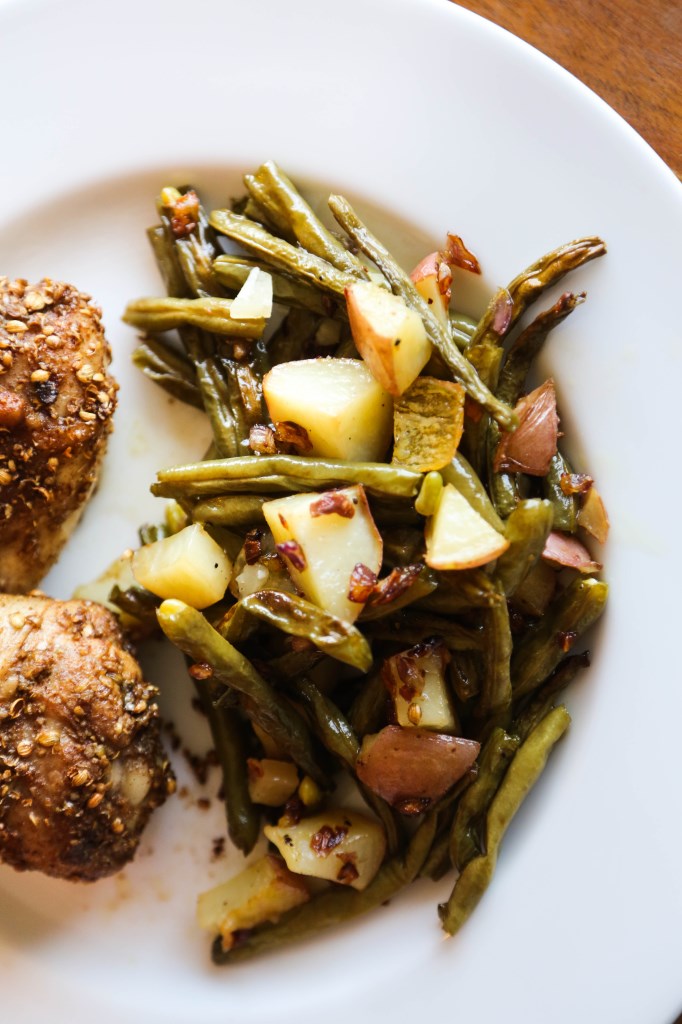
For the side, I did a simple roasted green bean/potato dish tossed with diced, caramelized purple onions.  Such a simple addition and it made the vegetables totally awesome.  Oh, and for my gluten/dairy avoiding friends, this meal is entirely safe for you!  FYI, just to keep things honest, Olive only ate the potatoes out of this dish.  She’s decided this week and last to boycott meats and most vegetables.  It’s been super fun…

Corriander Chicken007


Coriander Chicken with Roasted Vegetables
serves 4

1 lb chicken legs, thighs, wings – just make sure they’re still on the bone.  Yes, this can be done with boneless, but you’ll need to adjust the cooking time
2 tbs coriander seeds, crushed
1 tsp ground cumin
1 tsp cinnamon
1/2 tsp salt
1/4 cup olive oil

For the vegetables:
2 medium sized potatoes
1/2 lb fresh green beans, ends snipped
2 tbs olive oil
salt and pepper to taste
1/2 red onion, diced
3 tbs olive oil

For the chicken: Preheat your oven to 450F.  Combine the coriander seeds, cumin, cinnamon, salt and olive oil in a gallon sized Ziploc bag.  Add the chicken legs and smush and toss and move them around inside the bag to coat all the pieces evenly.  Sometimes I open up the bag and have to move some of the top pieces down to the bottom cause the bottom pieces are spice-hogs.  Leave the bag in the fridge for 30 minutes while you prep all the rest of the vegetables for the meal.

Wash and cube up the potatoes into about 1/2″ cubes.  Snap the ends off your green beans and wash them and pat them dry.  Toss the potatoes and green beans together with the 2 tbs of olive oil and spread them out on a greased, rimmed baking sheet.  Season with a good sprinkling of kosher salt and freshly ground pepper and set pan aside.  Take your chicken out of the fridge and arrange the pieces on a greased, foil-lined, rimmed baking sheet.  Place the chicken in the oven and set the timer for 30 minutes.  Put the potatoes and green beans in the oven on the lower rack beneath the chicken and get on with your onions.  In a medium saucepan, heat the remaining 3 tbs of olive oil over medium heat and cook the onions till they are golden, usually 10-15 minutes.

Check the potatoes and green beans when the timer for the chicken goes off.  If they haven’t turned golden and slightly crispy, leave them in there.  Check the temp of the chicken with a probe thermometer.  If it’s 165, they are done and you can remove them from the oven.  They may take longer depending on the size of chicken pieces you used and the temp of your oven (all ovens lie just a little bit).  If your vegetables aren’t quite done when the chicken is, just tent the chicken with foil so they’ll keep warm.  The beauty of the vegetables is that if they get done faster than the chicken, they can easily be warmed in the microwave.  When the vegetables are done roasting, toss them in with the caramelized onions in a bowl and season to taste with salt and pepper.

Corriander Chicken002


Turkey Meatball Stroganoff

turkeystroganoff003

For your Monday family meal, I am presenting something truly comforting, low in fat and wonderfully flavorful.  Coming, again, from Tyler Florence’s book, Start Fresh, this recipe appears at the back of the book where a few dishes are listed that the whole family can enjoy and be modified for any stage eater.  If I were feeding this to 9 month old Olive, I would smash up a meatball into tiny pieces (they are really soft, anyway) and I would take some of the sauce and pulse it a few times with a few noodles.  I’d even have taken a bit of everything for 6 month old Olive and blended it all up with some extra sauce!  I was never too worried about feeding her a huge variety at an early age.  For 15 month old Olive, this meal is a free-for-all.  I’m really strict when it comes to what and when she eats, but as for how, I still cringe, but I do let her eat with her hands, smash things in her face and even try and “smell” everything (which results in food up the nose).  I know I have a lot of guidelines, so I try my best to not stress too much about the mess.  I still won’t dump a scoop of spaghetti onto her try and leave her to it.  I have boundaries, you know.  🙂  But I think WHAT she eats and the way we treat mealtimes is more important than having to hose down the high chair.  (I’m preaching to myself.  This is a life lesson for me and my need to control things too much!)

turkeystroganoff002

Turkey Meatball Stroganoff*
Serves 4 to 6

1 slice multigrain bread (I used rye) or about 1/2 cup plain breadcrumbs
1.5lbs ground turkey
2 tbs whole milk
1/2 cup yellow onion, minced
1/2 tsp caraway seeds, crushed (just dump some in a plastic bag and roll over them with a rolling pin if you don’t have a mortar and pestle)
Pinch of kosher salt
2 tbs extra virgin olive oil
1 garlic clove, chopped
6 ounces sliced mushrooms (any kind)
1 sprig fresh thyme
1 tbs AP flour
1.5 cups low sodium chicken stock
2 tbs sour cream or unsweetened yogurt (I used the latter cause that’s what I had on hand!)
2 tsp Dijon mustard
8 ounces cooked egg noodles (I like the extra wide for baby hands to grasp!)
2 tbs chopped fresh parsley

Chop or pulse the bread in your food processor (or with a knife) until very small and crumbly.  In a large bowl, mix the turkey together with the bread, milk, onion, caraway seeds, and salt until combined (err on the side of too wet and add more milk if it seems dry).  Shape the turkey mixture into about fifteen 2-inch meatballs.

In a large skillet, heat the oil over medium heat until shimmering.  Add the meatballs and cook, turning often, until browned, 5 to 7 minutes (I have to use a meat thermometer for turkey and make sure I get the centers up to 160).  Transfer the meatballs to a plate.

Add the garlic to the same skillet and cook over medium heat for a minute or two.  Add the mushrooms and thyme and continue to cook, turning often, until the mushrooms are golden.  Sprinkle the flour over the mushrooms and stir to coat.  Stir in the chicken stock and cook, stirring, until the sauce has thickened, 5 to 7 minutes.

Whisk in the sour cream and mustard until smooth, then return the meatballs to the pan.  Turn to coat with the sauce.

Spoon the meatballs and sauce over the noodles and serve garnished with parsley.  I didn’t think this recipe made enough sauce, just FYI, so I think next time, I’d double the parts for the sauce.  Word to the wise!  I like leftover sauce and for the noodles to be absolutely coated!

*recipe adapted from Start Fresh

Fish Sticks and Sticking to Your Guns

fish and taters001

The method is working.  We have a few food rules when it comes to feeding Olive and ourselves.  All these thoughts are fueled by the game-changing book, “French Kids Eat Everything“.  I highly recommend it if you find yourself stressed that your kid eats a limited selection of foods.  Babies don’t know snacking exists.  They learn it soon enough from peers and tv and observing adults who randomly nibble throughout the day, but in the formative first couple years of life where you have most of the control over what your baby consumes, you can show them a different way.  And maybe even learn to eat better, yourself!  Olive gets one snack a day. Yes, she’s 15 months old (almost) and only snacks once a day. (And it’s a good one! Something fun and really tasty. Usually a piece of fruit or some dark chocolate and bread with milk.  You gotta make it something they look forward to.)  It’s in between lunch and dinner, because that’s the longest stretch without food.  We also have to emulate this discipline for her.  How would it be fair to snack in front of her without including her?  And if I want her to be hungry enough at a meal to be willing to try something new, well darn it, she needs to not have eaten a snack an hour before dinner!  Makes sense to me and it seems so obvious, yet so few do it.  We should all eat this way!  Hunger is a discipline that too few of us experience. And the discipline is learned before the age of two.  It can be learned if started after two, but it’s just so much harder (think: excessive whining).

We’ve even pushed dinner back to 7:30 the past few nights and she has eaten EVERYTHING.  Whereas before, I was serving dinner at 6:30 and it was a fight to get her to eat for 10 minutes straight (she’d had her snack just two hours before and had drank milk in between, so, consequently, she was only mildly interested in dinner.)  Eating an hour later has been a transformation –  she ate marvelously and ate everything from fish to broccoli to berries to a nice piece of Manchego (the King of Cheese).  So, it’s working!   The next day, she ate like a bird and acted like bananas were the devil (a  former favorite). Even if she has days like that, I try to remind myself that she will not starve and that maybe she’ll eat more at the next meal (this is SO hard.)  This structure of eating has made my days better, too.  I don’t have to constantly find something for her to eat.  Other than her snack, we’re all eating at the same time.  This will get harder as she gains the ability to ask for things and tell me she’s hungry.  I’ll tackle that problem when it gets here.  Hopefully between now and then, she’ll form the habit of knowing when food is served and being willing to wait till we can all sit at the table together for the family meal.  Also, because she eats so much quantity at each meal, she’s often not even that hungry until about 30 minutes before the next meal. So waiting for the meal is as simple as distracting her with playing in another room with Matt, or just including her in the cooking process like holding the herbs, or a peeled carrot, or whatever.  She sits on the counter a lot 🙂

The recipes today come from two cookbooks.  The fish recipe came from Tyler Florence’s book, Start Fresh, which is an absolutely wonderful book filled with recipes I would be just as happy eating as I would serving them to a toothless baby or toddler.  Toward the end of the book, there are recipes for the whole family to share.  My wonderful friend, Becky, sent this cookbook to me as a gift to me and Olive, and she put sticky notes all throughout the book with comments she made about which recipes looked good, which she wanted to try, etc.  It made me miss her so much and long for my genius-in-the-kitchen friend to be beside me, cooking and enjoying these recipes with me.  I’d recommend doing that to any cookbook you buy for someone – it just made it seem like she was here with me as I looked through it.

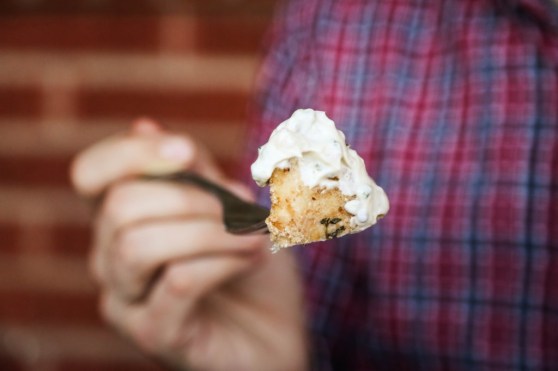
The tartar sauce recipe comes from the Bonne Femme cookbook and I swear to you, this is THE best tartar sauce I’ve ever had.  It puts every other tartar sauce to shame.  Makes them seem like a joke.  Like mayo with pickles.  This has tang and zip and crunch and so much flavor, I really will never feel satisfied eating any other tartar sauce, ever again.  (Dramatic, much?)  I’ve made two batches since last week and turned the latest batch into a potato salad.  Amazing.  You can’t go wrong with these recipes and I feel that this would even be an acceptable meal for a kid who does not like everything.  Surely on this plate, any kid could find SOMETHING they were happy to eat!
fish and taters004

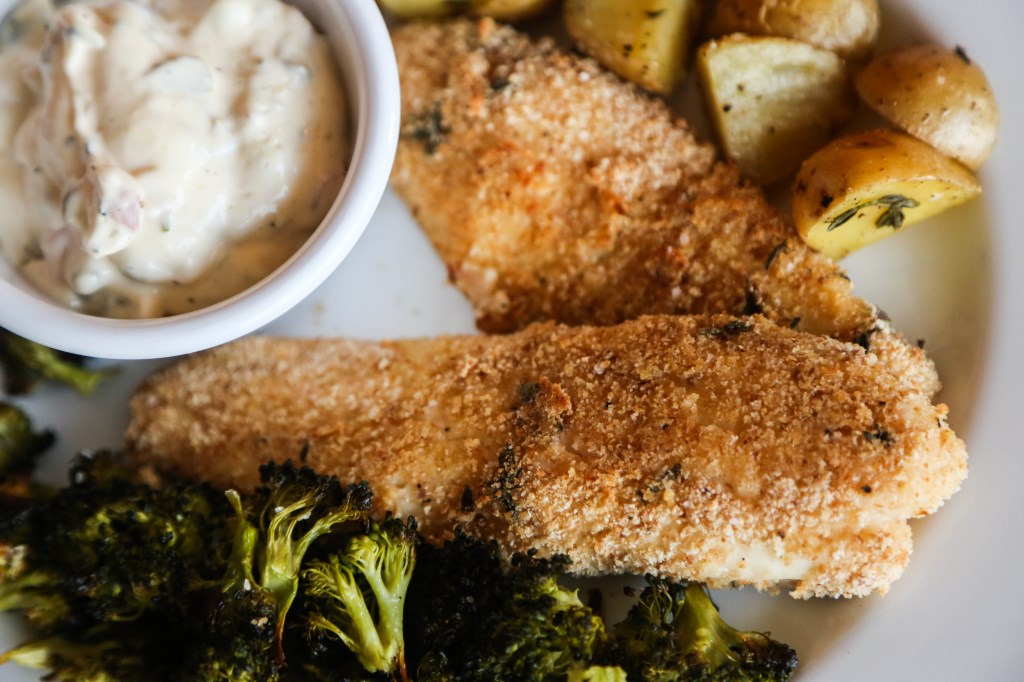
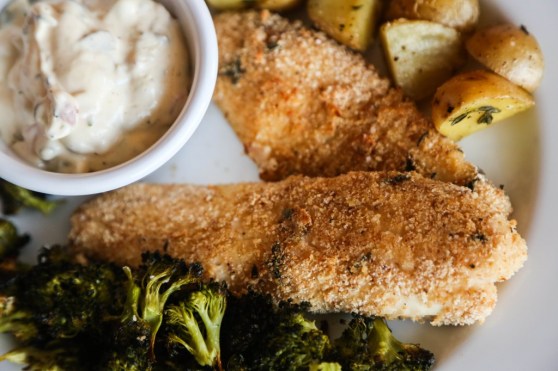
Oven Baked Fish Sticks with Roasted Potatoes
serves 4

1/2 cup buttermilk
1 lb cod or tilapia fillets, cut into 1 inch wide fingers
1 cup panko breadcrumbs (I ran out of panko and used plain and it worked fine)
2 tsp fresh thyme leaves
Salt and freshly ground pepper
1 lb assorted baby potatoes, scrubbed and quartered
2 tbs olive oil

Preheat the oven to 400F.  Line two rimmed baking sheet with parchment paper.

Pour buttermilk into a large bowl.  Add the fish pieces and turn to coat.  In another bowl, stir together the panko, thyme, and salt and pepper to taste.  Dredge each fish finger in the breadcrumbs to coat completely and arrange on a baking sheet.

Combine the potatoes (and broccoli pieces, or asparagus or green beans – whatever other green veg you want!) in a bowl and drizle with the oil.  Toss to coat thoroughly, then arrange the vegetables on the other baking sheet.  Bake the fish and vegetables, turning once, until the fish fingers are golden, about 15 minutes.  The potatoes may need longer.  If so, simply take the fish out when they’re done and tent with foil to stay warm.

Serve fish (and potatoes, really) with tartar sauce!
fish and taters012

fish and taters005

Tartar Sauce
makes about a cup

3/4 cup high-quality mayonnaise (we think, aside from homemade, that Hellmans REAL mayo is the best.  No low-fat or miracle whip crap.)
2 tablespoons chopped cornichons (small sour French pickles)
1 small shallot or 1 scallion (white part and some tender green tops), minced (about 2 tablespoons)
1 tablespoon finely chopped fresh parsley or fresh parsley and chives
2 teaspoons Dijon mustard
2 teaspoons capers, drained and chopped
2 teaspoons white wine vinegar or fresh lemon juice
2 teaspoons finely chopped fresh tarragon or chervil
Salt and freshly ground black pepper to taste

In a bowl, gently fold the mayonnaise, cornichons, shallot, parsley, mustard, capers, vinegar, and tarragon together (don’t mix too vigorously, or your sauce will be too smooth). Season with salt and pepper. Cover and refrigerate for at least 1 hour, and preferably 2 hours, before serving. Store, covered, in the refrigerator for up to 1 week.

fish and taters008

Bread: Guest post from Matt Palmer, a.k.a. The Bread Man

Alisa: I wanted Matt to write about the bread that he’s made countless times in the past seven years.  He started on a quest to learn to bake at the same time he wanted to become more likable at his office (to improve his performance review, which, the only thing that was negative was, “Matt’s kind of intimidating”) and so the two tasks naturally went hand in hand.  After one year of bringing bread in to the office every Friday, not surprisingly, there wasn’t a negative comment on his next review 🙂  Bread is the great equalizer.  This loaf, in particular, is beautiful in its simplicity, flavor, crusty exterior and soft, spongy interior.  Frankly, it’s the perfect loaf.  I think life has a lot of challenges, but if you could say that you could turn out a loaf of bread like this (given a day’s notice) any time it was needed, well, I’d consider that success.

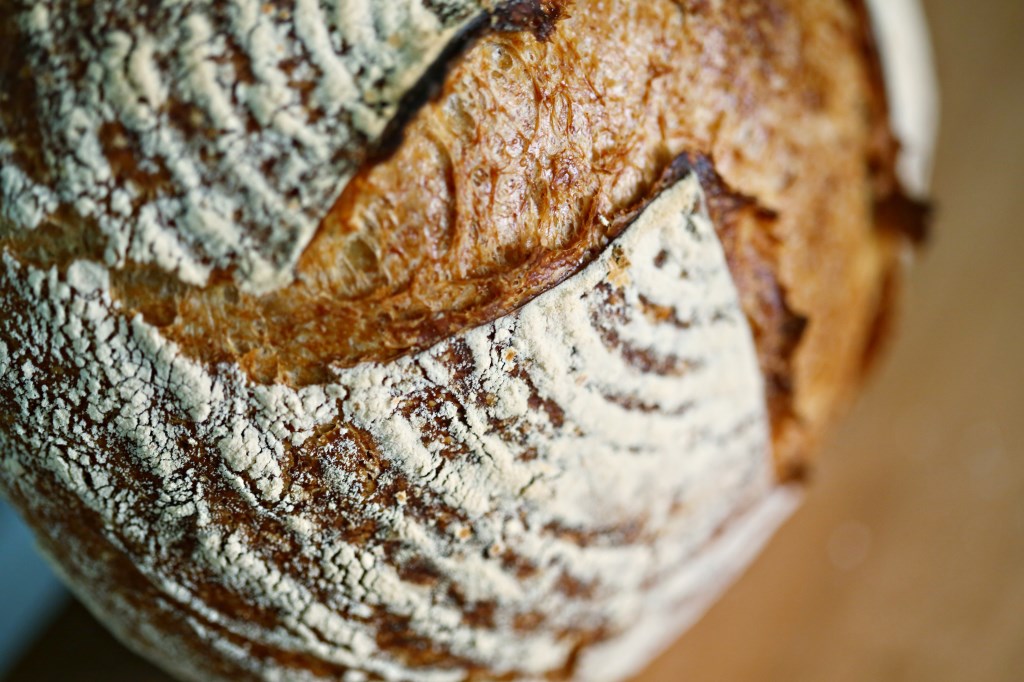
Country loaf close up

Matt: I like making things from scratch. I enjoy learning how things work, and with cooking you usually end up with something better than what you can get at the store – and it’s cheaper, better for you, and you even get a night’s entertainment out of it. So I guess it was just a matter of time before I got into baking. I’ve been making bread pretty regularly for a few years now, and I’ve certainly gotten better, but I’m still an amateur. Bread is one of those things that you could devote your life to (think Jiro Dreams of Sushi) and still find things to improve on.

That’s part of why I love it, but if that sounds disheartening to you, the good news is that even the poorest homemade loaf is better than anything you can get at the store. With a little bit of practice you can make bread better than you can get anywhere (unless you happen to live in San Francisco, New York, or a country that still cares about good bread). It’s kinda like chocolate chip cookies – the best bread you can buy where I live is essentially the bread equivalent of Chips Ahoy. Maybe you live somewhere with a bakery that sells something other than cupcakes, but unless the guy behind the counter looks like this, I’m guessing the bread there is still a Soft Batch at best. I’m sure the worst batch of homemade chocolate chip cookies that came out of your mom’s oven blows either of those away. The bread that will soon come from your oven is the same – once you’ve tried it, you’ll be hooked.
 Plain bread
Bread
21 oz bread flour (or AP flour if you prefer)
14 oz water (66%, for the bread nerds out there)
1 tsp instant/rapid rise yeast
2 tsp salt
Mix up the dry ingredients (you are using a scale, aren’t you?) and then add the water. Mix until the flour is all hydrated then cover it and set it aside for twenty minutes. (Or I could just say autolyse. See, you should become a baker, we have our own secret language.)
Stretch the dough out and fold it back up in thirds like you would a letter. Turn the dough 90 degrees and repeat, then put it seam side down in an oiled bowl. Wait ten minutes, then repeat. After three of these stretch-and-fold sessions your dough is probably developed. Put the dough back in the bowl and cover it and place it in the fridge overnight, or for up to 2-3 days (you might use less yeast if you know you’re going to wait several days to bake).
About two hours before you want to bake, take the dough out and let it warm up on the counter for a bit. Press it out into a circle (gently, we’re not making pie), then gather each side up to form a ball. Roll the ball in small circles on the counter to develop surface tension. This is a lot easier to understand when you see it, so you might want to watch a video.
Put the dough (now a boule, if you want to talk the talk) into a bowl lined with a floured towel. I use a basket called a banneton, which I flour directly, and it leaves little rings of flour on the loaf.
Leave the dough covered, on the counter to rise. This will probably take about an hour and a half, but you can tell if a loaf is still rising by poking it gently – if it springs back quickly, leave it to rise some more. If the indention stays, you’re ready to bake.
About a half hour before baking, preheat your oven to 450, with your baking stone, Dutch oven, or preferred baking device inside. You can bake on a sheet pan, and if that’s your plan you don’t need to preheat for very long. I recommend a Lodge cast iron combo cooker, which gives you the added heat while also trapping steam, and you can put dough into it without getting second degree burns, which is tough to do in a normal Dutch oven.
When the dough is ready, remove your preheated Dutch oven and flip the bowl over to put the dough into the pan. Make a couple of cuts in the loaf so it doesn’t rupture when it rises in the oven (this is called scoring), then put the lid on the Dutch oven and return it to the oven for thirty minutes.
Remove the lid from the Dutch oven and bake another 30 minutes.
Remove the loaf from the oven (the interior of the loaf should be around 200 degrees, if you want to make sure it’s done) and put it on a rack to cool. Lean in close and I bet you can hear the loaf “sing.” It’s tempting to cut into it right away, but I promise it’s better if you let it sit and finish cooking – think of it like resting a steak.
plain country bread loaf